We remember when we used to walk free to gather medicines, hunt for food, have our ceremonies and raise our families.
We remember.
We remember when we were asked to share the places where we walked free as a nation, where our ancestors walked before.
We remember.
We remember when freedom was taken, and we were confined.
We remember.
We remember when our children were taken and we had to have permission to visit them.
We remember.
We remember when after we were confined we needed permission to pick berries, gather medicines, hunt for food and practice traditions.
We remember.
We remember these things, we know how it impacts us. We remember. Now it’s time you learn our history, our losses and acknowledge your gain. We remember, you should too.
There is sadness within the people. This is deep inside and even though one maybe happy there is still an unexplained sadness that over takes them. It is sometimes diagnosed in the western world as depression but I think it is more that that. It is grief. This grief is profoundly deep. The wounds cut like a knife; it is a people’s grief.
This grief transcends time and experience. It is unknowingly passed down through the generations. We see it in the young people today. It is expressed through anger, gangs, and violence. The young people have suffered a loss but they are so unfamiliar with traditions that they do not know for what they grieve. We do not provide the tools to the young people because many of us do not know that we too are grieving.
Grief in its classical description points to a profound and significant loss in ones life. This loss would be a loss of culture but is also more than cultural experiences. It is a profound loss of spirituality. It is the connection to the spirit, to the Creator. This profound form of alienation has created a separation of the spiritual self from the physical self. It has caused the separation from the ability to grieve and recover. Elders will tell you to pray. This is the first step in reconnecting with self in the spiritual aspect.
It has been said by many different people of many different belief systems, that prayer is a powerful thing. That connection to the Creator allows you to begin your journey home.
When you pray you begin to adopt a feeling/attitude of respect. This is because you are praying to someone who is greater than you. You acknowledge that you are unable to change things on your own and you know that you need the assistance of a being greater than you. The Grandfathers and the Grandmothers in that spiritual sense would be Angels; beings that connect you to the Creator. When you ask for help and guidance you begin to change how you react. Your respect in prayer translates to your life. You begin to show respect to others as well as yourself. This respect further translates to respect for the earth who is liked to a mother because she provides for all her children, human and animal. Once this aspect of respect is recovered and learned the grieving process is started. Healing begins, and you are open to other lessons.
The sadness begins to lift. As you start your journey towards healing you begin to realize that the Creator has provided these experiences to you for a reason. You begin to realize that in every experience there is a lesson. It is simply finding it. Humility, thankfulness, love, compassion; all these experiences are brought forward. The profound sadness that once touched your life, the sadness that you couldn’t explain lifts. It sounds easier than it actually is because there are other processes involved too. There is forgiveness and letting go. This does not mean that you forget, it simply means that you treat others who may have done wrong to you with respect and love. If you continue to hold anger, hate (unforgiveness) in your heart it will continue to eat away at your spirit. Your spirit (soul) will suffer. You will believe that only bad things happen and that there is no love for you. The Creator loves all the children; the Creator forgives mistakes and wrongs. If you approach this life you have been given with love then situations will become easier to deal with.
First is respect, second is love. You cannot have love without also having respect. With love and forgiveness comes compassion. When someone deliberately tries to hurt you, you are able to recognise that his or her soul/spirit is in pain. Their pain is profound as yours once was. Therefore you treat them with respect, love and compassion. They will see that you have a new perspective and are able to treat them is a way that is right and honest. Your honesty may not be appreciated, depending on the depth of their pain. They may not be able to appreciate that you do not want anything, that you are not trying to manipulate them, that you are really and truly respecting them. Do not allow this to discourage you. You are living in truth. This truth is for your peace and balance and harmony not theirs. Your forgiveness is not conditional; it is for your own peace of mind. Bringing peace to yourself is a way to bring forgiveness to yourself as well as forgiveness to others.
The sadness may never be gone. In truth it may always be with you but it becomes a different kind of sadness. It is a sadness that you watch others still struggling with their pain. Pain is very powerful. It can rule a person’s life for many years without them even realizing it. You feed your pain by allowing hate and anger to consume you. You numb your pain by self-medicating through addictions be it drug, alcohol or lifestyles that you really don’t want to live. To release the pain, you must confront it with love and respect. These experiences have brought you to this place. It is up to you to choose where you will journey next. The Creator has given us this freedom of choice. You can choose love or you can choose hate. Freedom from the pain is through the acknowledgement of your loss. It is understanding your grief. Listen to the truth of your loss, speak to it, this sometimes means sharing your grief with others, sometimes it is through self-reflection and meditation. It is your journey and only you can decide where to go.
I’ve always been interested in history. I think it’s a family thing, my parents always told stories about historic events. There was a day my late uncle Archie brought me a bunch of old papers he found at the dump. He asked me to look through them and see what I could find. They were photocopies of black files from the Saddle Lake agency. These were a history that validated a lot of the stories. These records were of the interactions between the Canadian governments Indian Agent and the department of Indian affairs. They told a story of what happened in the community but are very one sided. These files are available through the Canadian archives.
This selection of papers my uncle gave me started me to looking for more information as i wondered if there was anything directly related to my family. When I was looking for more records online I somehow became distracted by old photos. I began looking at these old black and white photos online and became increasingly annoyed by what I saw.
What bothered me was that the photographers took the time to take photos but not the time to know whose photo they took. Sometimes if there was a European person in the picture, his name was included. Most often the pictures of the indigenous people said “unknown Indian”, sometimes “anonymous indian” or sometimes they named the tribe from where the person originated. What bothered me was that these were someone’s family members. They lived, they were loved and not forgotten when they died.
It bothered me because my great great grandparents could have been in those photos and I would never have known. It bothered me because the history I had been told about my dads side of the family is a sad tragic tale. It is inherently one of loss, loss of land, loss of culture, loss of freedom, loss of language, and loss of life.
My mosom Mumstahp’s father Memnook (sometimes spelled Maymenook) was killed in the great war. This isn’t world war 1, this is the 1885 northwest rebellion or resistance. Our family called it a great war. The story of his death is another tale. His father was named Witokan. We are told that he passed before treaty 6 was signed. We are told that he and his 6 brothers were the first to sign on the treaty at Saddle Lake. It was agreed to by them and ceremony was held at the corner where our family has their land.
After the treaty was signed all the family members received registration numbers, their names were included on the new band list. Maymenook was number 9 on the Saddle Lake band list. He was killed in May of 1885. His story was forgotten, not part of the Canadian history I learned in school. My mosom Mumstahp was given number 91 when he got married in 1904.
After the war the government, which had already broken many of their treaty promises created a list of “disloyal Indians”.
They needed permission from the Indian agent to leave the reserve, they needed permission to sell their produce. It was illegal for them to buy stamps, to hire a lawyer, to vote, and to gather, to practice culture and traditional beliefs. The government was trying to erase everything about who they were.
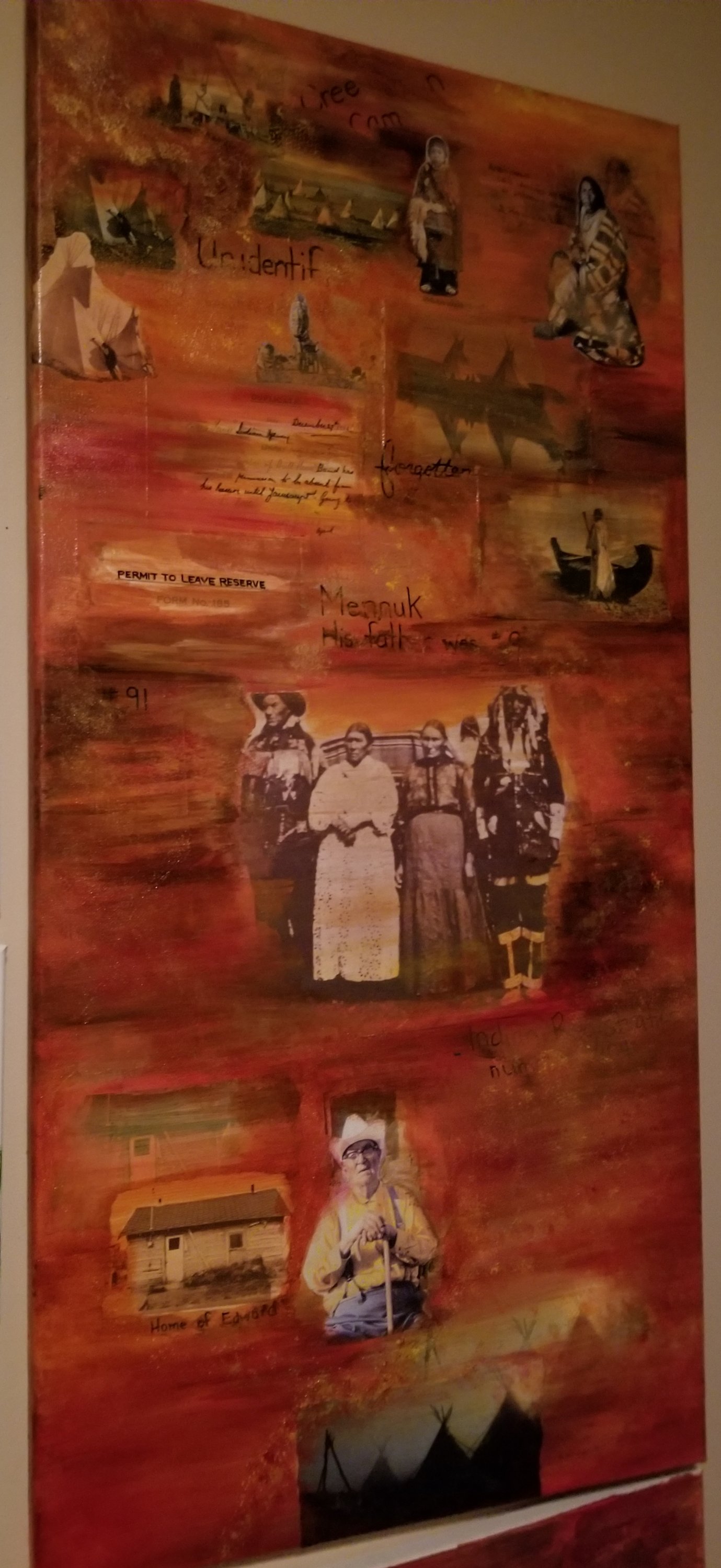
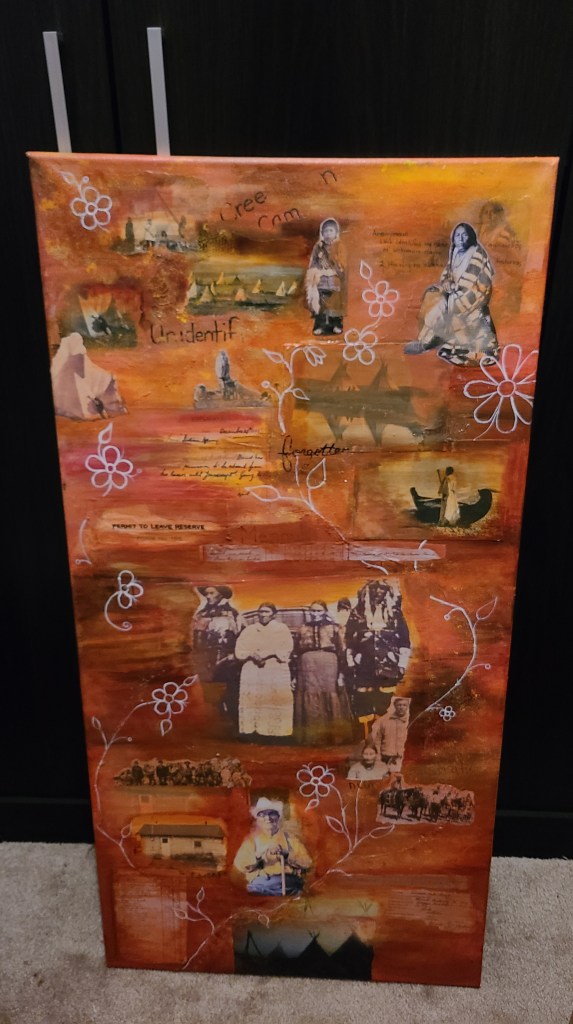
This painting is my way of illustrating that we are always connected to the past. We are connected by stories and shared history. Mosom Mumstahp was at least 106 years old when he passed away. I was 6.
This painting travels through history to connect with him with both the past and the present and it ends with the photo of tipi’s. The connection is illustrated through the flowers that wind through the painting. The tipi’s are a picture I took one morning when I was at the Saddle Lake cultural camp.
To me it shows resilience, that though much had been oppressed, we survived inspite of those who tried to erase Nehiyawak/Cree culture. It shows that those in the past are still connected to who we are today.
This painting represents hope. That although society saw a group of people and wasn’t interested in them; that society would rather forget about them, we are still here. It shows that the strength of our ancestors still resides in us.
I recently added to this painting, as I’ve learned more of my family history. I wanted to include elements that occurred to Mosom Mamstahp during his lifetime. I included a paylist, photos from life events and images on their numbers on the paylist.
We are still connected to what our ancestors experienced. It is part of who we are. The photos of those unnamed group of Cree people are still who we come from.
 Sakaw Iskwew