Tag: #Cree

Reflections on Grief and the Journey to Ones True Self
There is sadness within the people. This is deep inside and even though one maybe happy there is still an unexplained sadness that over takes them. It is sometimes diagnosed in the western world as depression but I think it is more that that. It is grief. This grief is profoundly deep. The wounds cut like a knife; it is a people’s grief.
This grief transcends time and experience. It is unknowingly passed down through the generations. We see it in the young people today. It is expressed through anger, gangs, and violence. The young people have suffered a loss but they are so unfamiliar with traditions that they do not know for what they grieve. We do not provide the tools to the young people because many of us do not know that we too are grieving.
Grief in its classical description points to a profound and significant loss in ones life. This loss would be a loss of culture but is also more than cultural experiences. It is a profound loss of spirituality. It is the connection to the spirit, to the Creator. This profound form of alienation has created a separation of the spiritual self from the physical self. It has caused the separation from the ability to grieve and recover. Elders will tell you to pray. This is the first step in reconnecting with self in the spiritual aspect.
It has been said by many different people of many different belief systems, that prayer is a powerful thing. That connection to the Creator allows you to begin your journey home.
When you pray you begin to adopt a feeling/attitude of respect. This is because you are praying to someone who is greater than you. You acknowledge that you are unable to change things on your own and you know that you need the assistance of a being greater than you. The Grandfathers and the Grandmothers in that spiritual sense would be Angels; beings that connect you to the Creator. When you ask for help and guidance you begin to change how you react. Your respect in prayer translates to your life. You begin to show respect to others as well as yourself. This respect further translates to respect for the earth who is liked to a mother because she provides for all her children, human and animal. Once this aspect of respect is recovered and learned the grieving process is started. Healing begins, and you are open to other lessons.
The sadness begins to lift. As you start your journey towards healing you begin to realize that the Creator has provided these experiences to you for a reason. You begin to realize that in every experience there is a lesson. It is simply finding it. Humility, thankfulness, love, compassion; all these experiences are brought forward. The profound sadness that once touched your life, the sadness that you couldn’t explain lifts. It sounds easier than it actually is because there are other processes involved too. There is forgiveness and letting go. This does not mean that you forget, it simply means that you treat others who may have done wrong to you with respect and love. If you continue to hold anger, hate (unforgiveness) in your heart it will continue to eat away at your spirit. Your spirit (soul) will suffer. You will believe that only bad things happen and that there is no love for you. The Creator loves all the children; the Creator forgives mistakes and wrongs. If you approach this life you have been given with love then situations will become easier to deal with.
First is respect, second is love. You cannot have love without also having respect. With love and forgiveness comes compassion. When someone deliberately tries to hurt you, you are able to recognise that his or her soul/spirit is in pain. Their pain is profound as yours once was. Therefore you treat them with respect, love and compassion. They will see that you have a new perspective and are able to treat them is a way that is right and honest. Your honesty may not be appreciated, depending on the depth of their pain. They may not be able to appreciate that you do not want anything, that you are not trying to manipulate them, that you are really and truly respecting them. Do not allow this to discourage you. You are living in truth. This truth is for your peace and balance and harmony not theirs. Your forgiveness is not conditional; it is for your own peace of mind. Bringing peace to yourself is a way to bring forgiveness to yourself as well as forgiveness to others.
The sadness may never be gone. In truth it may always be with you but it becomes a different kind of sadness. It is a sadness that you watch others still struggling with their pain. Pain is very powerful. It can rule a person’s life for many years without them even realizing it. You feed your pain by allowing hate and anger to consume you. You numb your pain by self-medicating through addictions be it drug, alcohol or lifestyles that you really don’t want to live. To release the pain, you must confront it with love and respect. These experiences have brought you to this place. It is up to you to choose where you will journey next. The Creator has given us this freedom of choice. You can choose love or you can choose hate. Freedom from the pain is through the acknowledgement of your loss. It is understanding your grief. Listen to the truth of your loss, speak to it, this sometimes means sharing your grief with others, sometimes it is through self-reflection and meditation. It is your journey and only you can decide where to go.
Madeline Belanger, March 2007 ©
Healing
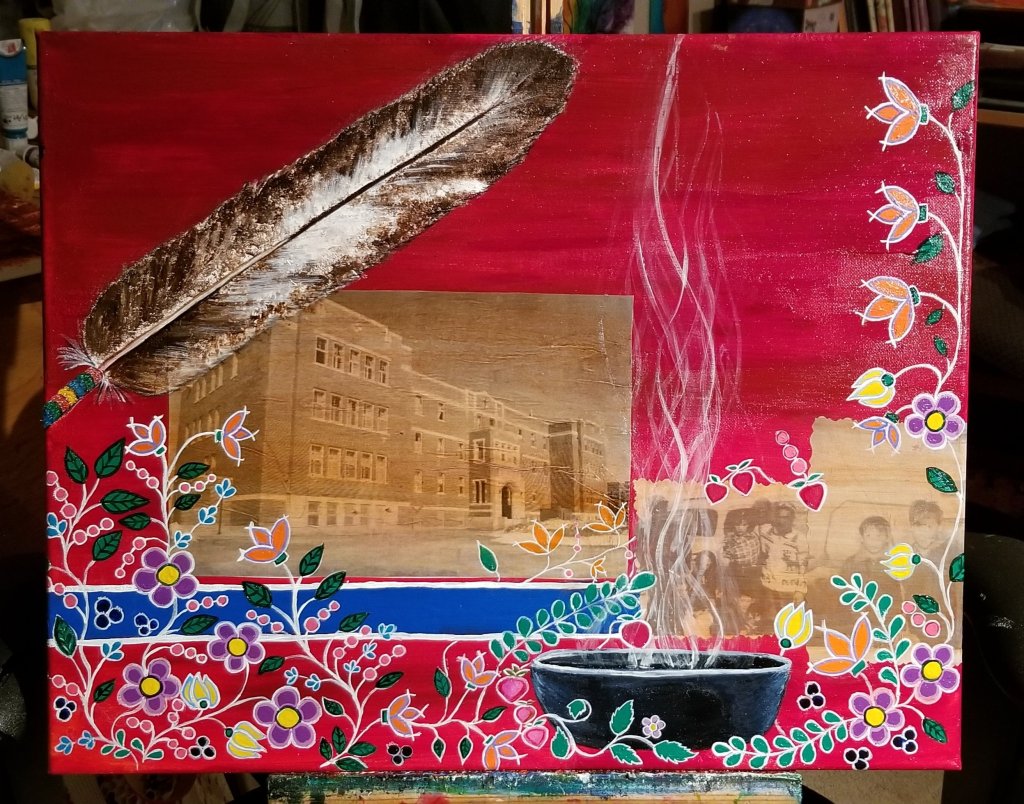
This painting represents how imposing blue quills has been on my family. There is a lot of intergenerational trauma because of it. This place caused a lot of physical, emotional and spiritual pain for my family. My dad and all his siblings attended there. My mosom (grandfather) and his siblings attended there. My Chapan, great grandfather he was fortunate enough to not have to go to residential school. However he did have the experience of losing his father at a young age, when his father was murdered during the 1885 northwest rebellion . (That’s another story)
This painting came to me one night while I was thinking about the impact that residential school had on my family.
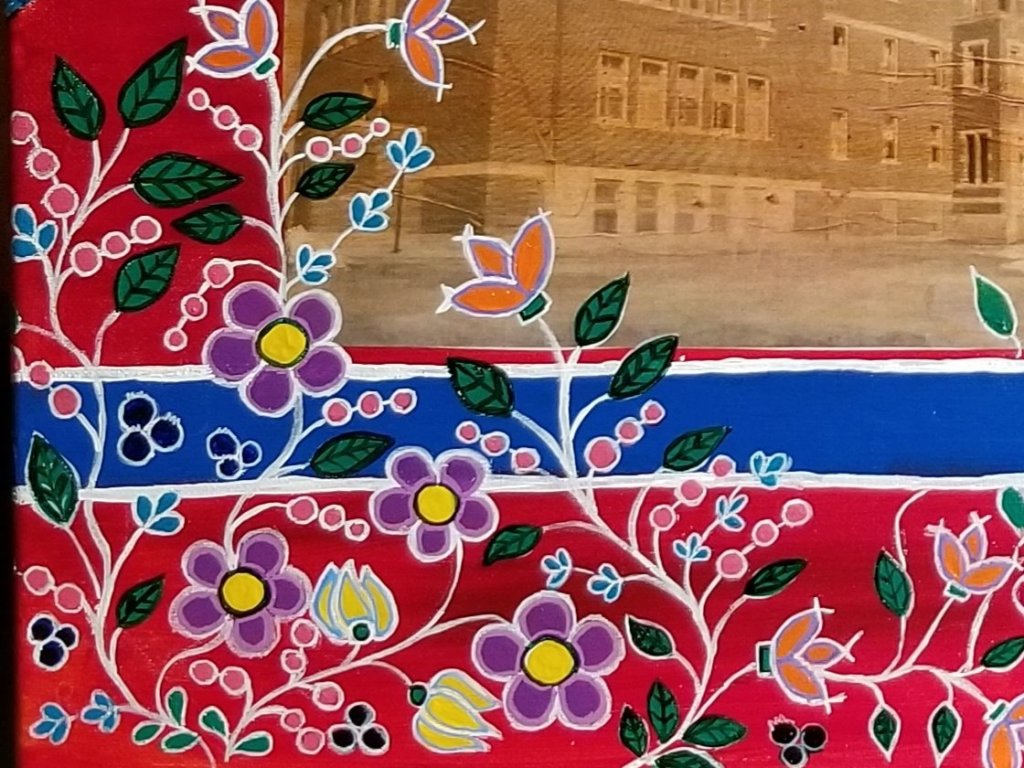
The flowers are growing over the photos and bringing healing and change. The photo of blue quills is large because it had a huge impact. It’s not covered because it will never go away.

The smudge and eagle feather are clearing away the pain through reconnection to culture.
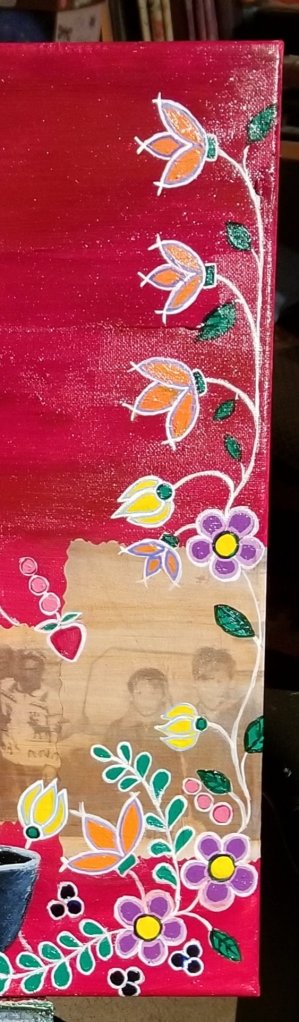
The photos are of my dad and his siblings. Each one of the flowers represents someone in my family. The purple ones are my dad and his siblings. The yellow ones represent myself and my siblings that’s why there are 5 of them. The orange ones are my parents grandchildren. The pink dots represent all of my cousins. The berries represent change and new growth. The sage also represents growth through healing. The background colours are there because of how this painting came to me.

Connections with the Land
Do you carry the land or does the land carry you?
Are you immersed and infused? Do you feel it in your blood?
Do you carry the land?
Does it walk with you?
Does it heal you?
Do you feel it within you? I feel the land, it is ever present in its beauty, in its calm and even in its wild freedom. The land exists in my heart and my spirit.
Where is the land in you?
Do you carry the land or does the land carry you?
When you walk through the bush do you feel the land? Can you see its gifts, it medicines, its life?
Do you feel it carrying you, sustaining you and healing you?
Does the land carry you? Are you connected to the land? Are you part of the land? Is it part of you? Do you hear it speak and feel its heartbeat?
It speaks through the rustles of the wind in the trees and grasses. It heals through connection. It heals through plant medicine and the water. It heals through its spirit. When I walk barefoot on the land, it sustains me with its gifts. I am infused within the land. My ancestors walked here, healed here, bled here, ate here. This land gifted my ancestors with life.
The land speaks to me. In the winter it speaks in the cold and the silence. The the spring it speaks when it awakens with new life. In summer it speaks in its beauty. In the fall the land speaks, with its gifts, relaxation and promise of restoration.
It carries me, it sustains me, it heals me.
I feel the land, it flows within me, I carry the land with me.
I carry the land and the land carries me.
What about you?
Do you carry the land or does the land carry you?
Returns
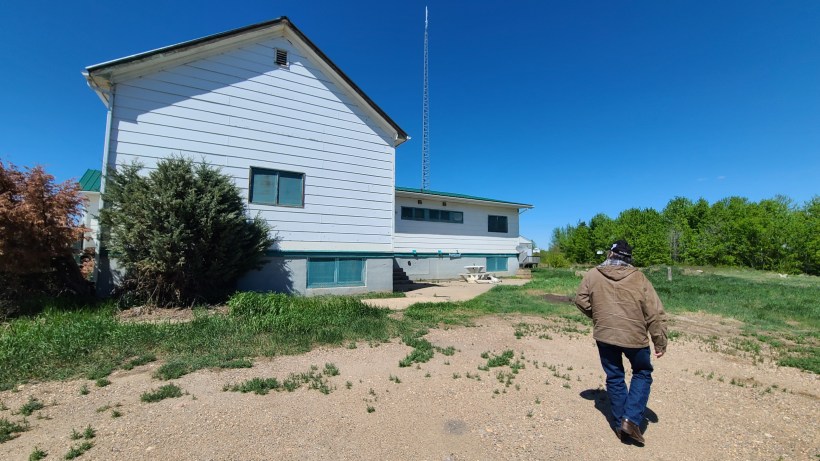
I walked into the school my father once attended never knowing he had been there before. I saw the Nehiyaw culture every where I looked but I felt something there that was unexpected. I felt dread and emotion that I did not understand and I thought it was because this was a residential school.
I thought that because I knew this had been hallways and dorms
where children were brought,
where they did not feel safe,
where bad things had happened,
that this was the reason for my fear.
I walked down the hall to where the library now stood, where once a chapel had been. I felt dread and disconnected from the reality of where I stood. I left and felt glad to be shedding the feeling of this place. Perhaps it was all in my head.
I returned home and told my father where I had been and where I had stood. He asked me why would I ever go there. I said I was there to learn about its history and its place now, as it tries to return culture to the people it stole from. I said “you should come there with me some time. There’s culture and language everywhere.” He looked at me and in a shaky voice half shouted “I will never go back to that fucking place.” I was shocked and shook to my core. I did not even think about my dad being in school there.
I remembered then the stories he told, brief though they were, of the nuns and how mean they were in school. I paused and I questioned, “I thought you didn’t go to school there.” He said quietly “It was only two weeks.” I did not say anything else but I thought his reaction was too strong for only two weeks. I didn’t ask again.
I went back there…to the school of two weeks…wondering how this place connected to me and my history. How was it connected to the pain my family experienced and as if the school could read my thoughts, I could not find a way into the building. None of the doors would open although there were clearly people inside. Someone came out and I caught the door and went in. The same feeling of dread surrounding me as I walked down the hall. I went to meet the person I had come to see, unfortunately, she had been called away for a family emergency. I left the building and immediately felt better.
Twice more I came to the building and was shut out. Twice more I left without answers. Then I went to a ceremony being held on the school grounds and I prayed that my dad would feel safe enough to tell me something; I shed tears for him.
A few days later my parents called. They said “can you please come here, we need you to look at some papers.” I went to their home and my dad handed me a brown envelope; he turned and walked away. I sat down at their kitchen table and asked my mum what it was. She said its about the time your dad spent at residential school. I said oh. I felt emotionally flat. I said I thought it was only 2 weeks. My mum said “no its longer and they only know he was there because other people identified him”. The school otherwise had no real records of him.” I felt anger burn in the pit of my stomach but I also felt sick. I asked “how old was he”….my mum said “just read the papers.” So I did.
It identified his timeline as at least two years and two months. I felt sick. I asked “What does this mean” I felt bewildered and confused. My dad came and sat down next to me. He asked “what should I do?” “They want me to go and make a statement.” I asked him “Do you want to?” He was unsure, unsure if he should open old wounds, unsure if he should talk about it, unsure if it was safe to do so. We smudged and prayed and I went home with even more questions.
I knew my uncles and aunties had gone to school there, they had said. My Auntie told me that they didn’t learn to read or write, that they had learned how to pray and to know that they weren’t good enough. She said my uncles learned how to work farm jobs. My Kokom had told me that they had been treated worse than dogs and that everything was rationed, they had to make do. Yet I couldn’t figure out why I didn’t think my dad had gone to school there. I guess because he never really said anything about it and because he had a substance use disorder, it wasn’t something that every crossed my mind. Now I had more unanswered questions. I also knew why my dad would walk away when anyone talked about going to school.
My dad called me a couple of days later and said “I’m going to do it but only if you and your brother will come with me and please ask your friend Wanda to come with us.” I said ok. nothing more, no questions just ok.
The day came for the independent hearing and I was nervous. We smudged and prayed. I gave my dad the things my children had given to me for Mosom; rocks for strength and a letter telling him that they knew he would be ok.
I listened to my dad’s story, the terrible things that had happened to him, the fear he felt, the pain he experienced and how it impacted his life. He he had suffered from depression, anger and suicidal thoughts for years. How he couldn’t be the father that he wanted to be but how he wanted to be a better Mosom. He showed them the gifts the kids had sent for him. WE were all crying. I understood my sense of dread and fear connected to that place.
I heard his story and understood my father on a different level. I saw him as a child, who had survived a horrible experience. How his dependence on alcohol for so long had kept him from thinking about those experiences and how his years of sobriety had helped him tell his truth.
I continued to go to that school to participate in the ceremonies every year that are held there. I always asked him if he would come. He always said no until about 5 years ago when he said maybe. Then he came with me. He was nervous and scared. As we drove closer he talked about the evil of the place and how much he didn’t want to be there. I asked him “do you want me to turn around?” He said no. We arrived.
He had returned. My nephew, the youngest grandchild at the time, was with us. He took his Mosom’s hand and we walked towards the building. My dad walked up to the building, took a breath and walked in. He had returned to his place of terror. He could only get through the door but that was more than I had expected. I felt proud of him. My mum looked at me as my dad said I need to leave the building and my nephew walked out with him. They walked around the grounds and we gave them time. Then we left. My dad seemed somehow lighter as we left.
The return was powerful, as was the ability to choose to leave. He had gained some freedom and I told him he didn’t ever have to go back there unless he chose to again. My parents, my nephew and I have gone back only once since then to attend a ceremony on the grounds but never to the building. I doubt if he will ever return to the building now that he has freely walked away from it.
We have an Elder at our school
I work at school that is not on a Metis Settlement or in a First Nations community. It has a majority of students that would identify, using school terms as FNMI, or First Nations, Metis, and Inuit. Our school is also very diverse with many cultures that are also strong in their beliefs and practices. As an Indigenous woman who went through the local school system it was important for me to support all students and especially “our” students. After having a student move from a remote Cree speaking community and hearing him preferring to speak Cree but not having people, including myself that really understood a lot of the language, I reached out to an Elder and asked her if she would be willing to come and just spend some time talking to him in school. Being able to build that connection for him. It was amazing to see how much his face lit up every time they would talk. Soon other students asked me how come he was the only one who was able to do that. I decided to go and speak to the principal of the school. This eventually led to us having a full time elder in residence at our school. I was asked by someone why it mattered and I answered it just does, which isn’t really an answer. So I had to ask myself “why is having an elder in residence good for the mental health of our students?” I thought a lot about it and this is the best way I could explain it.
I am an Indigenous woman and as such I explain things through story and the context of things relationally. This is how I will explain to you why having an Elder is good for the mental health of our students. As an Indigenous person it is important to me that we have cultural connections at our school. When I was a student going through the local school system there wasn’t always a good and accurate reflection of Indigenous people in our schools; as time went on that changed slightly.
I remember how in grade 4 we were offered a language choice but neither Cree nor Michif were offered at that time. I would have really liked to have had that exposure to my language. My parents did not speak Cree at our home because my mother could not speak it because she is English. My father is fluent in Cree as it was his first language. For myself I would hear it at church as the sermon was half in English and half in Cree. I would hear it when visiting family and friends. I would hear it when my dad would see people he knew up town so I was surround by it but did not speak it. I guess you could say my life was infused with it but not in a way that helped me to speak it.
In grade 9 we were offered Cree language but it was not taught by a Cree speaker. Rather it was taught by the French teacher and while she was nice, when we students would bring up cultural experiences she could not relate to us and we would often try to explain it to her. She would then tell us that we needed to move on and was not able to put those experiences we were talking about into a context. She would put on the tape so we could listen to the lesson and we would move on. It felt like our language and experiences weren’t important.
Throughout the grades we learned about Indigenous people as though we were dead, extinct and savage. We learned that people were crazy and bad; we learned that we were put down in the rebellions that were simply something minor and not anything big in the Canadian context; while my family taught me something else. My family taught me that one of my Mosom’s was killed in the great war and that his body was treated badly and we were not able to bring him back home. I was told we were not allowed to do anything and we were not allowed to ask questions or talk about our culture. If we participated in cultural practices we learned we were not allowed to let anyone know in case we would get in trouble. I heard from my family that schools were bad and that they hated us because we were “Indian”; that schools took away our language and our culture and were a place that mistreated us. In fact I heard stories from my cousins about how terrible teachers could be.
What I learned without knowing it was that this great war my family talked about, the one where we lost family, where people starved and died was not world war 1 but the 1885 north west rebellion. It was a war of survival and it was not actually a rebellion as much as it was about sovereignty. I was learning from my family a version of Canadian history. I learned that we had a way of life before colonization and that it was good. We had our own political governance structures, our own independence, our own revenue and that all these things allowed us to be who we were. I learned that when the Europeans came we lost that. I learned that there were treaties designed to allow the new people to share the land with us and I learned that did not happen. We lost a lot of our way of life through legislation that was imposed on us and through schools that were created to erase from our memories who we are. All these things have created legacies of both historical trauma and Intergenerational trauma.
So why am I telling you this, my children went through this school system trying to also connect with their identity, their culture and their language. They had a few opportunities, through a Cree language program, native arts classes and the opportunities given to them in high school. They had class debates where they were told by classmates that it was a long time ago and they should just get over it. My son asked me why his grade 7 social studies book called us savages and when I asked him what he learned he said that we are not very well educated and that our culture is mostly gone. This did not contribute very well to their positive identity. As my children are now adults one of the things that have discussed is the power of having someone who reflects who you are in the school.
The Elder at the school now was in the school when I was in high school. She did not have this same role and was not allowed the same conversations that she has now. We often talked and while I didn’t tell her anything personal it was really nice to have her there. She was around at the high school when my children were there. My kids knew that she would understand and that she would be a support if she could be. If she was allowed. These were not her roles at those times. We connected it because of cultural connections. She understood when I said I’m going to another funeral and didn’t say “how many funerals can you go to” making it seem like I was lying. She simply said I understand, that must be hard. She didn’t ask questions and didn’t say anything to my teachers.
In high school we also had another Metis lady who was good to talk to and when my cousin was murdered I tried talking to her about it but she wasn’t allowed to talk to me because again that was not her role. She told me that she was sorry but that she would get into trouble if she did talk to me about it. I could not talk to anyone else about it as there was nobody there who would understand. The two ladies that could have understood were limited by expectations surrounding their job.
Having an Elder in the school would have helped me. Having an Elder in the school would have helped my children because there are somethings that you do not have to explain why its happening they simply know. They simply nod and understand. Having that person who understands; that you are going to a wake, that you are having a rites of passage ceremony, that this is the 5th grandparent you have lost, is important. It allows you to be connected in a positive and healthy way, it creates comfort and safety and allows someone to explain the cultural aspect to your teacher when no one else can so that you do not have to. Indigenous people need those relationships, those connections and the understanding that it brings.
Having an Elder at the school allows staff to Indigenize the content and bring the curriculum into context through the oral histories and traditional teachings. It build a student’s pride in themselves, their language and cultural. It teaches other students that stereotypes that exist are not truths and it allows those students to connect with a culture that they might not otherwise be exposed to. It gives pride to parents and the community as a whole and it allows us to see that even though schools were a place that tried to make us forget who we were, that this school, our school is trying to help heal that wound. It helps not only the school, the students, the families but it helps everyone and that is why it is good for students mental health.
Silence
Silence,
It is deafening in its stillness and quiet
Kista?
Awina?
Neya.
I am silent.
I am mute.
What do I say?
These words are lost to me.
These words I should know.
Tapwe.
I should be able to speak but I am silenced.
The nuns and the priests they took away the language.
I heard it in my youth.
My father’s first language. He learned not to speak and to remain silent.
It is spoken to others, who also spoke…those not totally mute, not totally silenced but still they did not speak it to me. I am silenced.
Sometimes words want to come, not lots of words only some. Then fear takes hold and they go away.
I do not know enough language to get by.
I know a few words but still fear gets in the way so I remain mute.
Silenced.
The silence is deafening in its stillness and quiet.
Thanks to that school I am silent. I am mute.
Walking
I am walking, feeling the rhythm, I hear the distant beat of drums. They call to me, telling me to come home.
I try to find my way, I stumble and fall, I rise and follow the sound, growing stronger like a heartbeat. I hear the voices of my ancestors calling me, “Nosim, you will be ok, granddaughter do not be afraid, you will find the way.”
I walk closer to the earth, feeling more grounded and connected as I stand barefoot on the earth. I search, sometimes stumbling as my walk gets closer. I feel the heartbeat of the earth as I walk under the sky. I know that Creator is showing me the way. I am walking back to myself, back home, finding comfort in the old ways.
Ceremony calls. I let go of my pain. I let go of my fear. I am walking a new yet old road.
I am walking, feeling the rhythm, I hear the not so distant beat of drums. They call to me, telling me I am home.

Medicine Gifts
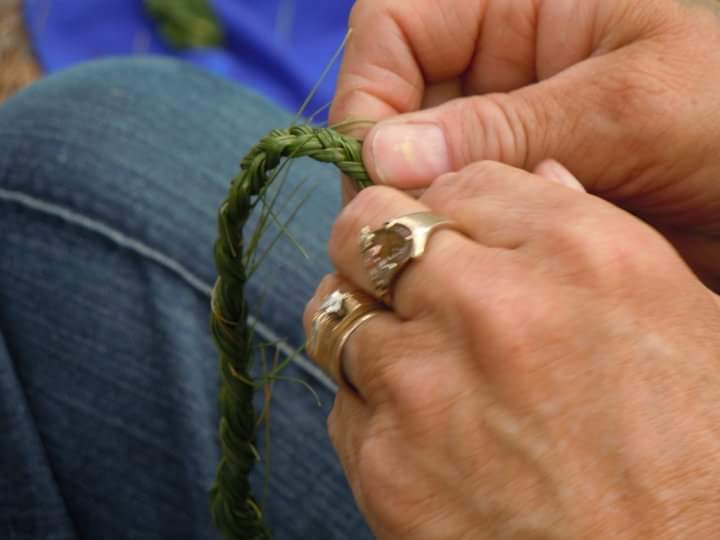
One summer several years ago when we were camping at mile seven. My Aunt, my fathers first cousin, Alsena met us there. We had been camping for several days when Auntie Alsena joined us. One afternoon we spent picking medicines and ĺearning about the plants that we were picking when Alsena told us that her friend Diane was going to meet up with us. She had camped there with us before. When Dianne showed up she had brought sage and sweet grass with her. We learned about creating sage bundles and sweetgrass braids. Once we finished making the braids and bundles we took them and hung them up to dry in the breeze off the lake.

Then we began to clean the roots and prep the medicines. As we were cleaning the medicines Dianne and Alsena were telling stories of the medicines and how we got them.
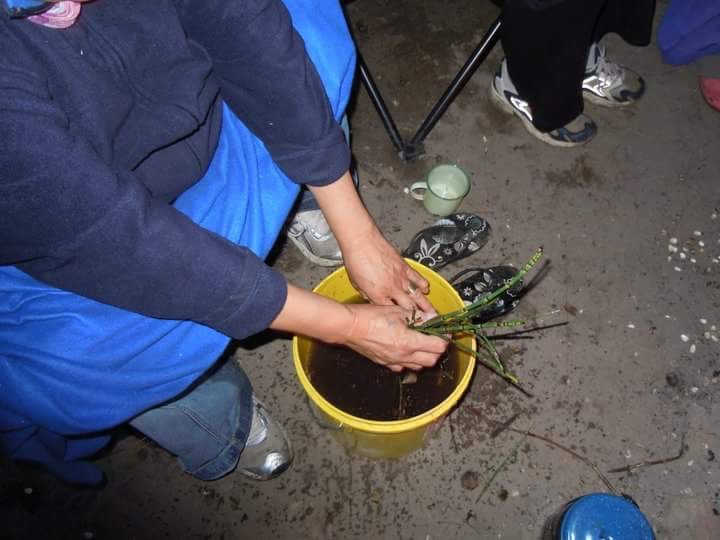
One of the medicines was spruce gum. This medicine, spruce gum, was/is used as an antiseptic. It helped to hold skin together when someone was injured. It was/is used to treat colds and is added to other medicines depending on the need. The story we were told was about the gift of spruce gum and how badger gave it to us. The badger told the people how to use it for medicine and food. Alsena said that one man was lost in the bush for two weeks in the winter and he ate spruce gum to help sustain his body.
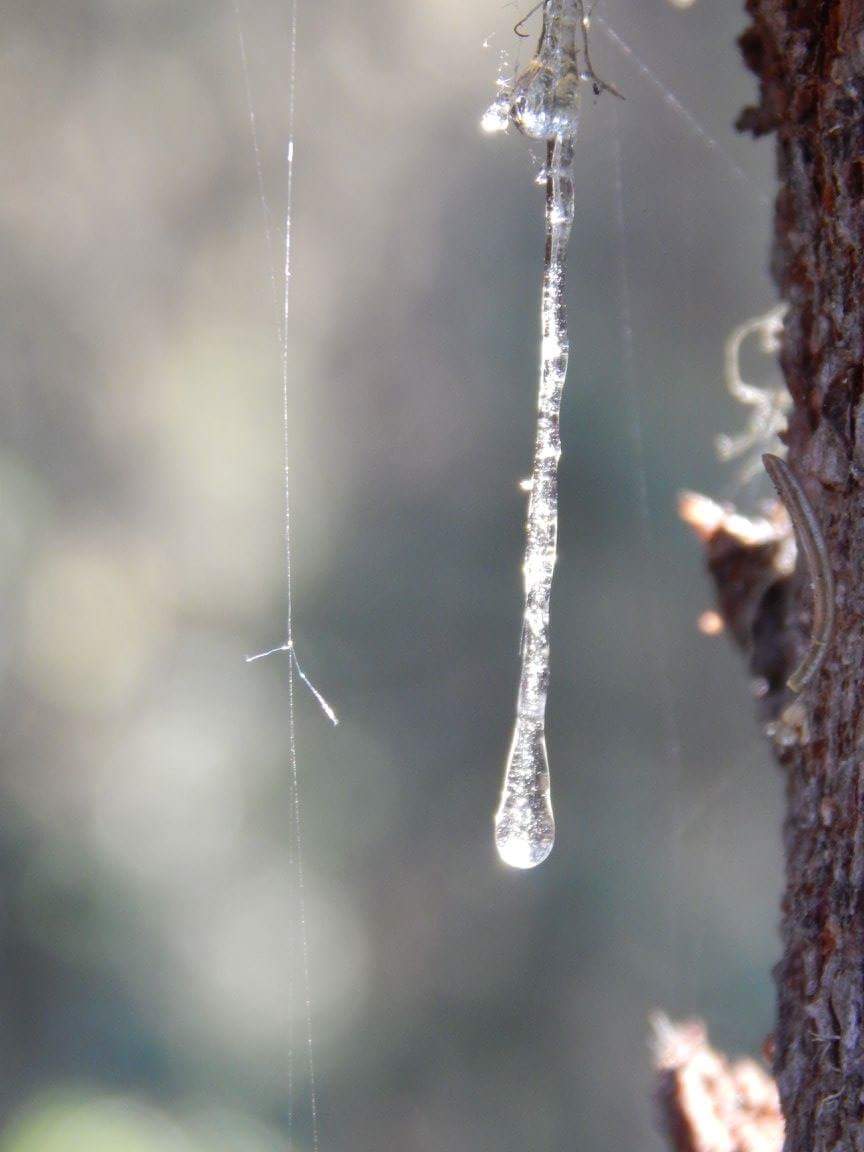
There are so many plants that can help people with their health, it’s important that we keep this knowledge strong and that we spend time with those who know how to treat people.
 Sakaw Iskwew