Family history

I’ve been told about my family’s history and told I should remember it, so I do. This is how we start.

In the beginning… we were here, we were here from time immemorial, from before colonization, before Canada and before the treaties. We come from people who were autonomous and independent. We had our own creation story, our own history, our own math and science. We hand our own medicines and medical practices. We educated ourselves. We took care of ourselves. We knew our history, our laws, and practiced our culture freely.  As time continued we experienced changes and made contact with new cultures and new ideas. We considered ourselves equal to these people. They did not consider us their equal and sought to exploit us.

We found the changes that were occurring were faster than we expected, and we were asked to enter into agreements to share the land.  So we entered into ceremony, prayed, and asked for guidance towards this end. In 1876, we were guided and therefore agreed to enter into a sacred treaty. This was done to benefit the people. We thought that because we we had entered into an agreement through Sacred Ceremony, that they would honour the sacredness and truth of the treaty. We thought they would follow through on their word to help us.

We did not agree to give up our independence, nor did we agree to give up who we were, our laws, our traditions, and our ways of being. We did not think they would continue to steal from us, not only taking all the land we agreed to share but also eventually our children. We did not think we would lose our autonomy, nor did we think we would be forced to give up our culture, language, and traditions to fit into another nations society. Their society.

So our family history is always told with the prefaced context of what happens next. This is the story of our family and its journey to now. It’s about how history has impacted us as best as I can tell. It’s about our relatives and who we come from. It’s the story of us.

Legacies

I once attended a conference day, where I worked. The organizers invited a woman, a holocaust survivor, to come and speak. She spoke of the legacies we leave behind. She expressed the wish to honour the legacies her parents gave her. With this consideration, I wish to do the same. Her parents did not know what legacies they gifted her. I wish to acknowledge the gifts that I have received from my parents just as this woman had legacies from both her mother and her father

I believe the greatest legacy I have received from my mother is the gift of love. Not just regular love but deep abiding and unconditional love. She taught me no matter how someone behaves or speaks; you must always treat that person with love because you do not know the pain the individual carries with him or her. 

My mother always approaches everyone with the love of a family member. Even when someone mistreated her, was cruel or unkind, my mother still held a place of love and respect in her heart for that person. This was the way that my mother taught me to forgive. My mother has always said forgiveness is not about the person you are forgiving. It is about releasing you from the bond of that other person. She taught me that if I did not forgive whatever it was that happened to me; I would become an angry and resentful person. She told me that if I became unforgiving, then the person who harmed me would win, and I would always give up my personal freedom to that person. In essence, I would be controlled by that person and the hate and anger I may feel towards them. 

 My mother taught me quiet strength. She did this through her deep abiding faith. Whenever there was a crisis in our lives, whenever things seemed crazy and out of control, my mother would calm us down and pray. She would tell us God is always with us, even in the bad times. My mother’s absolute belief that we are not alone in this world has carried through in all that I do. I live my life in constant prayer. I talk to God at all times. Some people would think it’s crazy to pray about knowing the right thing to say or to feel a sense of peace, but this is one of the lessons my mum taught me. Pray often, and do not be afraid to talk to God.  

My mother exemplified kindness, always willing to share whatever she had, always willing to look out for her fellow human being. My mother did not shirk away from people that might make others uncomfortable. She believes in the power of respect, kindness and most of all love. My mum loves all of her nieces and nephews equally and is always so happy to see them. She loves her family in England endlessly and carries that love equally strongly for her family in Canada. To my mum, family is everything. It is family who carries you into this world when you are little. They are the ones who give you strength when you are sick. Family is who continues and remembers you after you are gone. Even when your family struggles with life problems, it is your family that you turn to for help when you are struggling along the way.  

My father has given me a different legacy than that of my mother. He has taught me the value of never giving up. He teaches me endurance through adversity, and most of all, he has taught me that you can overcome all that you struggle with. These are the lessons I choose to learn from him. These are lessons we learned from him as adults. The lessons we learned as children were different, as he was so wounded by his past. 

My father carried a lot of pain inside of himself. It caused him to fear, distrust, and carry anger for many years. Sometimes, those feelings still jump up and trigger him to act in ways he would rather not. He once told me “Carrying pain is a terrible thing.” He said “When you continue to carry it, it can eat you up inside and destroy your life.” He said, “Shame also builds within you and is what silences you.” He told me, “It is only in letting go and forgiving that you can be free.” He said, “If you continue to try to cover it up and not face your experiences, you hide from your truth. When you hide from your truth, then you don’t see how your choices are impacting others.” He taught me it is alright to say you’re sorry and to admit when something you have done has hurt those that you love the most. 

My dad also taught me bravery. He taught me this by continuing to try to quit drinking and by finally succeeding in his sobriety. He also taught this to my brother and I when he invited us to sit and bare witness his story of what happened to him at residential school. As I listened to his story and heard of his traumas and watched him get triggered by memories of things that happened, not only at the residential school but along the way in his life, I saw him in a different way. I saw the child in him that was hurt. I saw what it took for him to tell us ‘this is what happened to me’. I understood more about my father in that moment than I had ever before.

My father was also a contradiction. His life experiences caused him to repress who he was. It caused him to deny his heritage and to be angry with many things. He would not speak his first language, nor would he practice any traditions. He was not able to allow this part of himself to exist, so great was his shame of his own identity. A lot of things cause him pain even still.  It causes him hurt when people don’t believe we are his children because we don’t look the way we are supposed to, and that makes me sad. Yet he talks about us with pride and speaks of our accomplishments because they are an extension of his own. I am glad he is proud of us, of my kids, and the legacies I am trying to pass on.  In learning how to deal with all those previously repressed feelings, my dad had to relearn care, compassion, understanding, and kindness. He had to accept himself, his past, and his future. This is where my parents taught me that no matter what; the people you love, love you too. 

There is also a history I carry with me. It is the history of the Cree/ Nehiyawak people. It is the oppression and colonisation and the stories passed on in our family. I carry this legacy of hate with me. This is not by my choice; this is the legacy of racism. It is in the history of Canada. It is difficult for people to acknowledge that it exists. It is based on a fear that perhaps they have behaved in a racist manner. Racism, it is not really gone. It is subtle. It is in the way people talk about “others”.  I see it in the way people respond to different aspects of myself. I see it when people tell me “well you don’t look that Native” like that’s a good thing or “Wow your dad is really native” or “That’s your real dad?” I also see it when my people tell me “You look so Moniyawak but I knew you couldn’t be because I heard you speak” or “I knew, because you said you were from Saddle Lake.” These statements strip from me the self I believe I am and place me always into the category of other. I never truly belong to one group of the other. I feel the pain of it in my heart when I hear people speak with such disdain about things that they do not understand. 

When people speak with authority about “ancient history,” they fool themselves into believing there is not a problem that exists. There is no reconciliation in this. We live in a world that allows hate to fester and grow: where it’s okay to say, “They should just move forward because it’s better for them to let it go.” Sometimes I am told, “Jeeze, they should just get over it.”  No one would say that to a holocaust survivor or a survivor of genocide such as what happened in Rwanda or in Cambodia.  It’s just not “polite”. No one would tell the child witness of a murder, “Just get over it” or “It didn’t matter” to the child witness of assault, to children who experienced violent persecution, physical, sexual or emotional abuse and assaults. No, we say that as a society, we would empathise, provide understanding, and treat them with care and love. Yet this is not what really happens. If we are real and honest with ourselves, the reason we say, “it happened a long time ago”, “it wasn’t us who did that” or “I am not responsible for that” is because it is too painful for people to acknowledge the impact of our behaviour on others. This is the legacy I carry with me when I sit and bite my tongue because I don’t want to offend anyone with the truth I carry in me. An example is when people tell me racism doesn’t exist anymore, and I think back to my first real experience with that as a child with my father in St. Paul and being harassed by an RCMP. I think back to walking with my cousins, down the road in Saddle Lake to get candy as a way to have a break from a funeral we were at and having a vehicle drive past us and these young boys scream obscenities at us, calling us names. I think about how people have treated my family members with suspicion and scorn for no other reason than for how they look. I wonder how anyone can pretend that behaving like that is normal. It seems society believes that because “they” are different from us, it’s alright to be ambivalent to the way children were so cruelly treated. 

If I can provide my children with the legacies my parents have provided me, then that is half the battle. I try to give my children, my nieces, and nephews a new perspective. I try to help them treat those people with unconditional love, kindness, and respect. I strive to be forgiving and brave and to carry the truth with me. Yet I am only human. I make mistakes. I get angry and feel hurt. Since I am human, I can learn. I can learn and speak to the truth because it is how I gain freedom.  I am reminded once again of what that lady said to us. She said “This is not about all the terrible things that happened in my life. It is about learning to forgive and to teach people how to love one another.”  If I can leave that kind of legacy to my children and those people who cross my path in life, then I will know I have lived a good life. 
Medicine Gifts

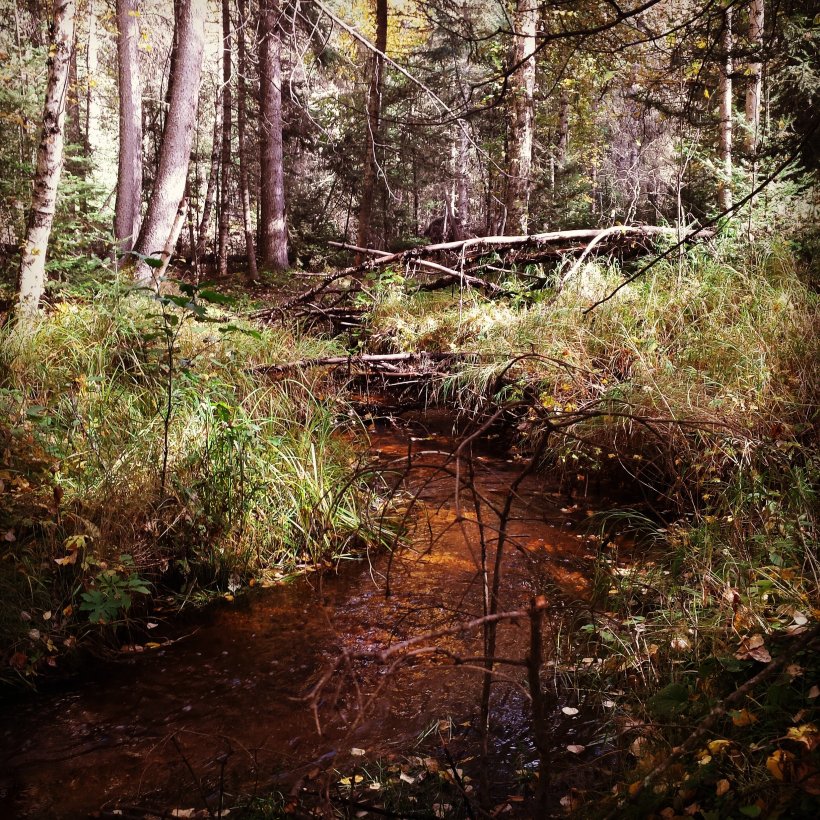
Touchwood creek

Medicine has been gifted to people. Every culture has its own understandings of medicine and what that means. Medicine is learned, it is taught, it is lived. In Nehiyawak culture medicine can be plants, it can be ceremony, it can be spending time in nature or with others. The word medicine has many different meanings. In this way there are many different ways to seek healing. Medicine is what makes you better.

One summer several years ago we went camping at mile seven. My Aunt Alsena, my father’s first cousin, met us there. Our purpose in going there’s was to pick medicines, there are several different kinds in that area.

We had spent the afternoon picking medicines and auntie Alsena told us that her friend Diane was going to meet up with us. She had camped there with us before. When Dianne showed up she had brought sage and sweet grass with her.

We learned about creating sage bundles and sweetgrass braids. Once we finished making the braids and bundles we took them and hung them up to dry in the breeze off the lake. 

Then we began to clean the roots and preparing the medicines. As we were cleaning the medicines, Dianne and auntie Alsena were telling stories of the medicines and how we got them.  We learned how the medicinal plants were used and why we are so connected to the land. This connection itself is a form of medicine. Just being out on the land brings healing in various ways.

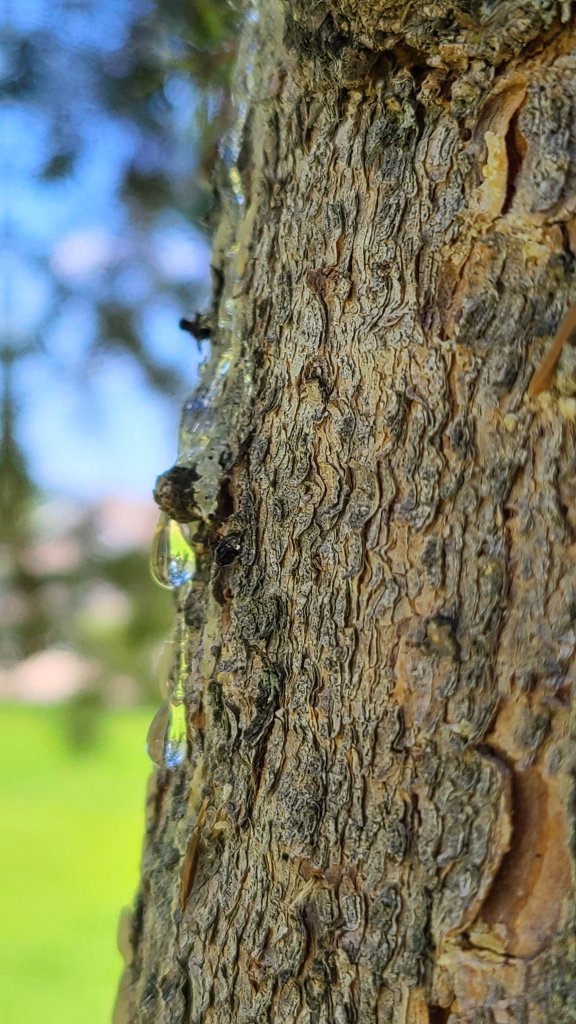
One of the medicines we learned about was spruce gum. This spruce gum is used as an antiseptic. It fights infection. It helps to hold skin together when someone is injured. It is used to treat colds and is added to other medicines. It can be used for food too.

We were told the story of the gift of spruce gum and how badger gave it to us. Badgers are fierce and dangerous animals. A long time ago they were very big, much larger than they are now. They were bigger than people, and they used to kill and hurt people. The people prayed to the Creator for help, because we are weak and we need help to survive. The Creator told badger to stop harming people. That did not happen. Eventually the Creator had to do something about badger. The people had chased two baby badgers up a tree. Creator told them that because badger had not respected the request to live peacefully they would be changed. They would no longer be bigger than the people, they would remain the size of their babies. They would provide help to the people through the warmth of their fur, etc. The baby badgers were grateful that the Creator allowed them to live and they promised to help the people. When they slid down the spruce tree their claws cut open the bark and the tree sap came out. The badgers told the people that this was their medicine that they were sharing it with the people as a way to make amends. They taught the people what its used for and how to use it. There are stories for all medicines. Storytelling helps you to remember the medicines and how and why they are used.

Auntie Alsena also told us about a man was lost in the bush for two weeks in the winter. His snowmobile ran out of gas and he tried to hike out of the bush. He got lost and ran out of food and water. To survive he ate spruce gum and drank melted snow to help sustain his body. He survived and was rescued. She told us all that spruce gum is full of vitamin c and will help us if we need it.

All of these activities were each a form of medicine. Each thing gave us something different to heal us. It balanced our spirits through the camping and story telling. It taught us ways to help ourselves in a crisis. We learned the medicinal properties and usage of plants. We laughed and found purpose in what we did. We built connections and created memories that will last a lifetime. All this is good medicine.

The Warrior

In 1990 when I was 18 there was a stand off in Oka. I watched the news every night worried for the people who were fighting for their land. I watched as the government criminalized the Indigenous people. I watched as racism raised its ugly head and hate filled the hearts of many people. I ended up writing this poem about the warriors that were fighting.

Tall, brave, defiant stand the young warrior. Praised by his people for his valor, fighting for his cause.

Yet people once friends now label him an enemy. Insulting things that they do not understand. They call him names and laugh in scorn at the proud warrior

“What is this they fights for?” they ask. “A piece of land, what possible meaning could it have?” They suggest to give up; for they believe it is a lost cause.

Still he, the warrior, remains resistant, standing with gun in hand, ready, waiting for the tanks to lumber across the land, his ancestral home. The burial ground of his grandfathers. That is why he fights.

He fights for that final resting place, his historic homeland. He, the warrior is fighting for something that belonged to his forefathers. His land by right, snatched from the hands of his predecessors. Into a corner his ancestors were pushed; now his generation comes out fighting.

His people were forgotten, pushed away until now. For now his people have taken a stand, wanting to get back what is rightfully theirs.

I wrote this on August 28, 1990 during the Oka stand off. For those who were on the front lines and those that were there in spirit.

Silence

Silence,

It is deafening in its stillness and quiet

Kista?

Awina?

Neya.

I am silent.

I am mute.

What do I say?

These words are lost to me.
These words I should know.
Tapwe.

I should be able to speak but I am silenced.

The nuns and the priests they took away the language.

I heard it in my youth.

My father’s first language. He learned not to speak and to remain silent.

It is spoken to others, who also spoke…those not totally mute, not totally silenced but still they did not speak it to me. I am silenced.

Sometimes words want to come, not lots of words only some. Then fear takes hold and they go away.

I do not know enough language to get by.
I know a few words but still fear gets in the way so I remain mute.

Silenced.

The silence is deafening in its stillness and quiet.

Thanks to that school I am silent. I am mute.

Broken Bowl – The story of my bowl

20170516_221720

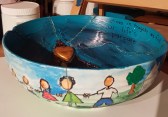
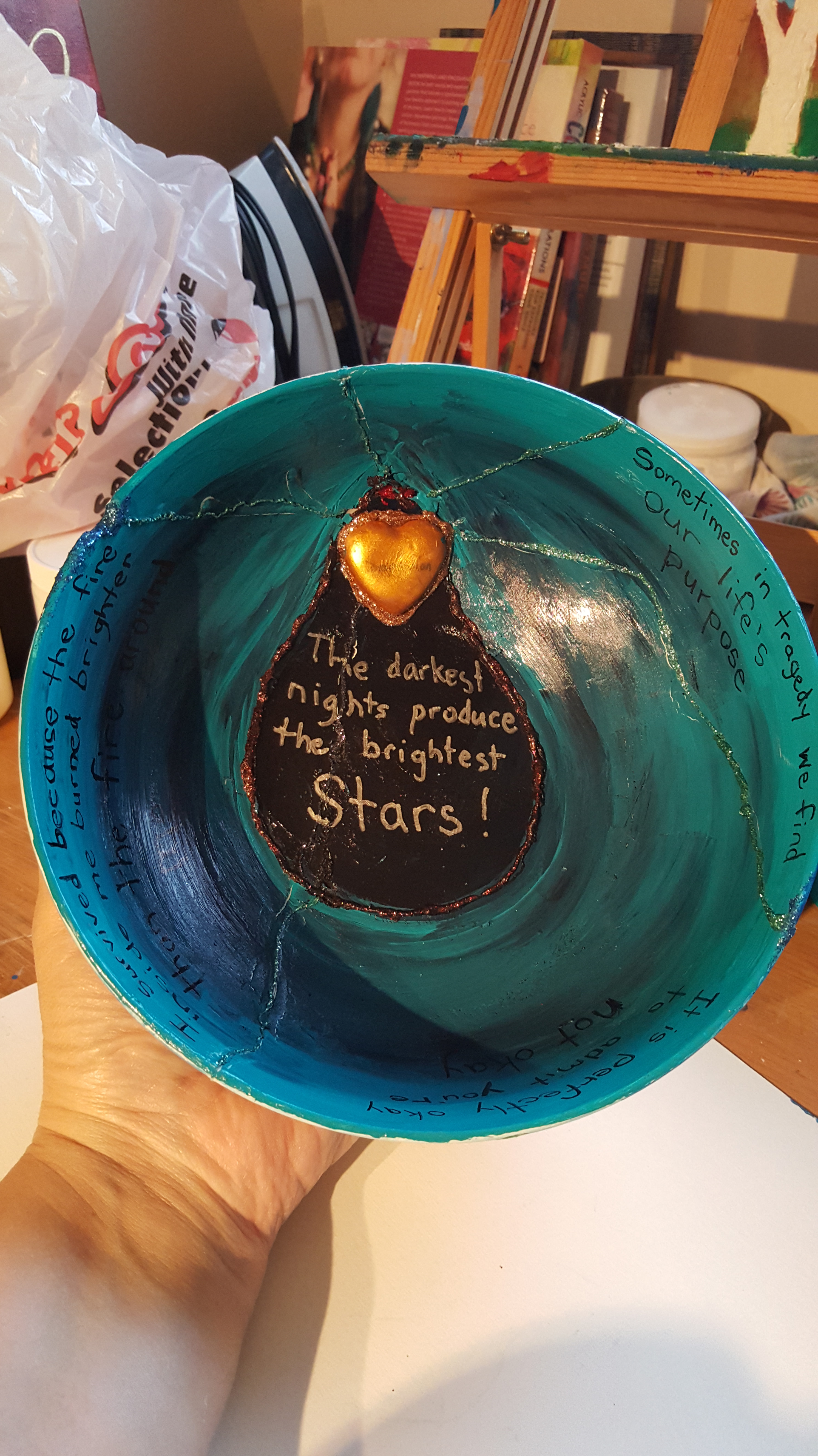
The broken bowl, the idea is that we are all similar to bowls, we carry around with us the experiences of our lives and somehow we are able to put ourselves back together. This doesn’t always happen right away but it does happen. It is a process that we sometimes need help with and sometimes we are able to do this ourselves. I had thought of doing this project previously but had not stopped to take the time to gather what I needed. When my supervisor asked me if I would help her with it I thought that it was a good chance to try it out.

As we sat at the board room table painting the gesso on the bowls I was contemplating. I considered what I would put on the bowl, what would it reflect about my grief and loss. I thought about how my parents had separated when I was in grade 7. I thought about the addictions and violence that was in my childhood home prior to their separation. I thought about all the people that I loved and had since lost over time. All these experiences contributed to who I am, they have made me the person that I am and shaped the destiny that I have followed. I put these thoughts aside for a bit while I went back to my regular work day but I felt unsettled. I went online and looked at some quotes on grief and loss. Some were so depressing and some were way to “I shall overcome”. These experiences sat with me while I ran a group for self esteem and I continued to feel as though I needed to let go of some of the thoughts. I was glad to be able to start the project. I knew what I wanted to start with.

20170516_164525

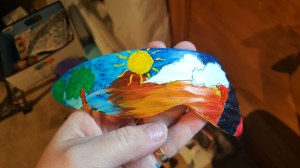
When I went to break the bowl and I had a difficult time to do this. I didn’t want to many shattered pieces; it was as though I didn’t want to have as many broken pieces of the bowl as there might actually be in my life. I also felt guilty breaking the bowl as it did represented part of me, I asked my husband to do it for me. I had to explain the idea behind the bowl and as always he helped me. I brought it back to the office to begin this process. I placed all the pieces out on the table and contemplated. Then I decided that the place where the bowl had been broken was similar to my heart. So I decided to paint a red heart around the hole. This was the start of a several hour process. I then decided that I wanted blue sparkle paint over the top of the heart and black sparkle paint at the bottom. The reason for the sparkles, without the darkness there is no light. The reason for the blue above is because when I feel sad I go outside, turn my face towards the sun, close my eyes and look up. The sky makes me remember that there is light when there is darkness.
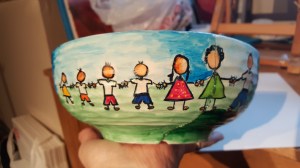
Next I drew. I decided that it would be easier to draw what I wanted to paint. I decided at that point to draw like I was a little kid. So I drew my family. I drew my mom between two of the broken pieces because my mom was always trying to keep us together. It didn’t always work and if the power of love and her will could have kept us all ok, it would have.

20170516_201727

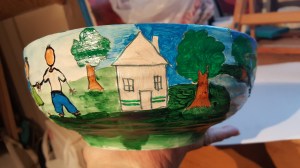
I drew all of us holding hands because we always went everywhere together. Sometimes as kids we hated that, there were 5 of us kids and we all received the same amount, no one ever really got anything more than the other. We even used to divide a box of smarties between all of us and any extra went to my parents. I put my dad on the other side of us kids because of the separation and his leaving. On the same side as my dad I drew a house. We lived in a trailer that had green stripes on it.

We lived in Kikino Metis Settlement, so I drew trees because we were always climbing trees and outside exploring. I also drew the river because in the summer we would go swimming in the river almost every day with all the other kids on our road.

20170516_201737

When I painted the sun it was high in the sky but underneath the storm clouds is a sunset because everything changed and my life living out of town and being free to roam around ended when my parents separated. The sunset is attached to the black because I thought I would never get over losing my home, the land that I used to run barefoot on and the freedom that I had.

My family continued to change and that broke my heart. It was like there was a huge hole in my heart and I thought everyone who met me could tell just by looking at me. I turned inside myself for a long time. It then felt strange to glue the bowl together again. It felt like I should be able to make it look the same and hide the cracks but I couldn’t. Then I remembered that my experience created who I am and it doesn’t define me. Its just a part of me.

Once it was time to paint the inside of my bowl this too was hard to decide what to do. There was a huge hole in the side of the bowl. I tried filling it with some of the pieces from the bowl and while it covered it up it didn’t change the fact that there was a gaping hole in the bowl. Then I saw a heart that I had been given by a stranger at the truth and reconciliation event in Edmonton. I decided that I would put that on the hole. This heart said compassion. I thought it was a reflection of how other people have helped me to heal and move forward as well as a reflection of self-care. So I glued it over the hole. I’m not perfect, I have healed some of my emotional pains but it will always be something that stays with me. I painted the inside of the bowl black and then turquoise. I then decided that although the cracks will always be there I have learned some things about myself and being resilient so I decided that I would use sparkle glue to make the cracks stand out but they are the same colour as the paint so its really only if you look closely will you have the benefit of seeing the beauty that comes from the breaks.

Finally I put 4 quotes into the inside of my bowl. These quotes both remind and encourage me. The first is written on the black teardrop in the center of the bowl. It says “The darkest of nights produces the brightest stars.” Again to remind me that even in the darkness I can shine. The next quote is “Sometimes in tragedy we find our life’s purpose.” This is because I became a counselor because of my experiences and I try to help others with theirs. The third is “It is perfectly okay to admit you’re not okay” This is to remind me that I also have to take care of myself. The last quote is personal and a quote by someone named John Graham. It says “I survived because the fire inside of me burned brighter that the fire around me.” This is to always remind me that I am alright and that I can be alright. In all the difficult situations that have happened in my life, I have walked through the other side.

What is your bowl’s story?

20170516_203333
“The darkest nights produce the brightest stars”