Legacies

I once attended a conference day, where I worked. The organizers invited a woman, a holocaust survivor, to come and speak. She spoke of the legacies we leave behind. She expressed the wish to honour the legacies her parents gave her. With this consideration, I wish to do the same. Her parents did not know what legacies they gifted her. I wish to acknowledge the gifts that I have received from my parents just as this woman had legacies from both her mother and her father

I believe the greatest legacy I have received from my mother is the gift of love. Not just regular love but deep abiding and unconditional love. She taught me no matter how someone behaves or speaks; you must always treat that person with love because you do not know the pain the individual carries with him or her. 

My mother always approaches everyone with the love of a family member. Even when someone mistreated her, was cruel or unkind, my mother still held a place of love and respect in her heart for that person. This was the way that my mother taught me to forgive. My mother has always said forgiveness is not about the person you are forgiving. It is about releasing you from the bond of that other person. She taught me that if I did not forgive whatever it was that happened to me; I would become an angry and resentful person. She told me that if I became unforgiving, then the person who harmed me would win, and I would always give up my personal freedom to that person. In essence, I would be controlled by that person and the hate and anger I may feel towards them. 

 My mother taught me quiet strength. She did this through her deep abiding faith. Whenever there was a crisis in our lives, whenever things seemed crazy and out of control, my mother would calm us down and pray. She would tell us God is always with us, even in the bad times. My mother’s absolute belief that we are not alone in this world has carried through in all that I do. I live my life in constant prayer. I talk to God at all times. Some people would think it’s crazy to pray about knowing the right thing to say or to feel a sense of peace, but this is one of the lessons my mum taught me. Pray often, and do not be afraid to talk to God.  

My mother exemplified kindness, always willing to share whatever she had, always willing to look out for her fellow human being. My mother did not shirk away from people that might make others uncomfortable. She believes in the power of respect, kindness and most of all love. My mum loves all of her nieces and nephews equally and is always so happy to see them. She loves her family in England endlessly and carries that love equally strongly for her family in Canada. To my mum, family is everything. It is family who carries you into this world when you are little. They are the ones who give you strength when you are sick. Family is who continues and remembers you after you are gone. Even when your family struggles with life problems, it is your family that you turn to for help when you are struggling along the way.  

My father has given me a different legacy than that of my mother. He has taught me the value of never giving up. He teaches me endurance through adversity, and most of all, he has taught me that you can overcome all that you struggle with. These are the lessons I choose to learn from him. These are lessons we learned from him as adults. The lessons we learned as children were different, as he was so wounded by his past. 

My father carried a lot of pain inside of himself. It caused him to fear, distrust, and carry anger for many years. Sometimes, those feelings still jump up and trigger him to act in ways he would rather not. He once told me “Carrying pain is a terrible thing.” He said “When you continue to carry it, it can eat you up inside and destroy your life.” He said, “Shame also builds within you and is what silences you.” He told me, “It is only in letting go and forgiving that you can be free.” He said, “If you continue to try to cover it up and not face your experiences, you hide from your truth. When you hide from your truth, then you don’t see how your choices are impacting others.” He taught me it is alright to say you’re sorry and to admit when something you have done has hurt those that you love the most. 

My dad also taught me bravery. He taught me this by continuing to try to quit drinking and by finally succeeding in his sobriety. He also taught this to my brother and I when he invited us to sit and bare witness his story of what happened to him at residential school. As I listened to his story and heard of his traumas and watched him get triggered by memories of things that happened, not only at the residential school but along the way in his life, I saw him in a different way. I saw the child in him that was hurt. I saw what it took for him to tell us ‘this is what happened to me’. I understood more about my father in that moment than I had ever before.

My father was also a contradiction. His life experiences caused him to repress who he was. It caused him to deny his heritage and to be angry with many things. He would not speak his first language, nor would he practice any traditions. He was not able to allow this part of himself to exist, so great was his shame of his own identity. A lot of things cause him pain even still.  It causes him hurt when people don’t believe we are his children because we don’t look the way we are supposed to, and that makes me sad. Yet he talks about us with pride and speaks of our accomplishments because they are an extension of his own. I am glad he is proud of us, of my kids, and the legacies I am trying to pass on.  In learning how to deal with all those previously repressed feelings, my dad had to relearn care, compassion, understanding, and kindness. He had to accept himself, his past, and his future. This is where my parents taught me that no matter what; the people you love, love you too. 

There is also a history I carry with me. It is the history of the Cree/ Nehiyawak people. It is the oppression and colonisation and the stories passed on in our family. I carry this legacy of hate with me. This is not by my choice; this is the legacy of racism. It is in the history of Canada. It is difficult for people to acknowledge that it exists. It is based on a fear that perhaps they have behaved in a racist manner. Racism, it is not really gone. It is subtle. It is in the way people talk about “others”.  I see it in the way people respond to different aspects of myself. I see it when people tell me “well you don’t look that Native” like that’s a good thing or “Wow your dad is really native” or “That’s your real dad?” I also see it when my people tell me “You look so Moniyawak but I knew you couldn’t be because I heard you speak” or “I knew, because you said you were from Saddle Lake.” These statements strip from me the self I believe I am and place me always into the category of other. I never truly belong to one group of the other. I feel the pain of it in my heart when I hear people speak with such disdain about things that they do not understand. 

When people speak with authority about “ancient history,” they fool themselves into believing there is not a problem that exists. There is no reconciliation in this. We live in a world that allows hate to fester and grow: where it’s okay to say, “They should just move forward because it’s better for them to let it go.” Sometimes I am told, “Jeeze, they should just get over it.”  No one would say that to a holocaust survivor or a survivor of genocide such as what happened in Rwanda or in Cambodia.  It’s just not “polite”. No one would tell the child witness of a murder, “Just get over it” or “It didn’t matter” to the child witness of assault, to children who experienced violent persecution, physical, sexual or emotional abuse and assaults. No, we say that as a society, we would empathise, provide understanding, and treat them with care and love. Yet this is not what really happens. If we are real and honest with ourselves, the reason we say, “it happened a long time ago”, “it wasn’t us who did that” or “I am not responsible for that” is because it is too painful for people to acknowledge the impact of our behaviour on others. This is the legacy I carry with me when I sit and bite my tongue because I don’t want to offend anyone with the truth I carry in me. An example is when people tell me racism doesn’t exist anymore, and I think back to my first real experience with that as a child with my father in St. Paul and being harassed by an RCMP. I think back to walking with my cousins, down the road in Saddle Lake to get candy as a way to have a break from a funeral we were at and having a vehicle drive past us and these young boys scream obscenities at us, calling us names. I think about how people have treated my family members with suspicion and scorn for no other reason than for how they look. I wonder how anyone can pretend that behaving like that is normal. It seems society believes that because “they” are different from us, it’s alright to be ambivalent to the way children were so cruelly treated. 

If I can provide my children with the legacies my parents have provided me, then that is half the battle. I try to give my children, my nieces, and nephews a new perspective. I try to help them treat those people with unconditional love, kindness, and respect. I strive to be forgiving and brave and to carry the truth with me. Yet I am only human. I make mistakes. I get angry and feel hurt. Since I am human, I can learn. I can learn and speak to the truth because it is how I gain freedom.  I am reminded once again of what that lady said to us. She said “This is not about all the terrible things that happened in my life. It is about learning to forgive and to teach people how to love one another.”  If I can leave that kind of legacy to my children and those people who cross my path in life, then I will know I have lived a good life. 
History

I am a survivor – yes, a survivor of history, a survivor of residential school. Though I did not attend, I was never the less there. I survived it. I was there, I was there before I was born.

This is not ancient history, a story, it is real and it is my history.

I survived the hurt, the anger, the fear – the tears – the sorrow – the betrayal of trust. A child’s trust, the loss of that innocence.

I survived. I survived the wicked behaviour called “discipline”. I survived the shame, humiliation, self-hatred and the loss. “You are nothing, you dirty Indian”

I survived the losses.
The loss of language, culture, history and pride.
THE LOSS, THE LOSS, THE LOSS!!!
The loss of safety, security, and the loss of family, for generations.

How can this be? How did I survive, you ask???

I did, I survived….
I am a survivor of my fathers pain and my Mosom’s shame. I am a survivor of the betrayal, two generations of “education”.

Yes, I did not go to residential school but my family did. My family was sentenced there. The terms were carried out over several generations, sentencing that carried a legacy, holding us, stealing life from us, slowing us, paining us.

It taught my family not just reading and writing. It taught shame, self-hatred and created the need to forget.
It taught my Mosom Self-loathing, it raised him up in foreign ways. It told him “remember your place” “say your prayers, you’ll go to hell” and it created shame, shame, shame.
It taught my father to forget. The only direction to turn – ANYTHING to help you forget. But it was not gone. It never leaves, it was ALWAYS there. It is always there.

It is there in the fear and the tears and the sorrow. It is there in the behaviours, the promises and the inter-generational sorrow. The trauma that still holds.

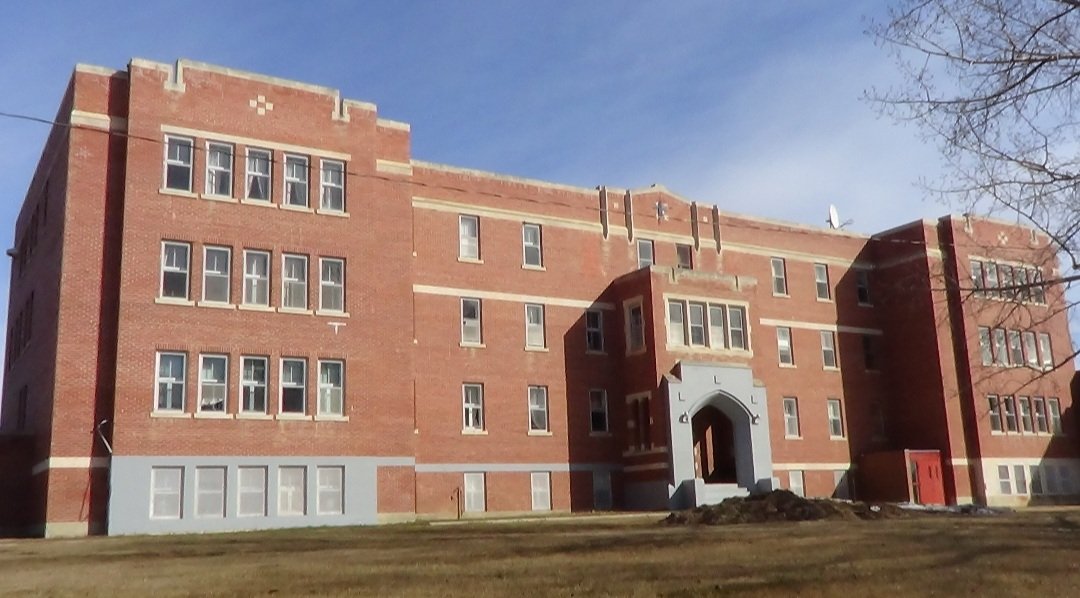
Yet I have survived. I walked into that building, feeling the fear, struggling to make myself go inside. I cried. I cried for those children who never left, whether that was through experience or death. I cried so that I could be free. I survived.

I will not let the former shame claim another generation. “I will be okay, we are okay” “TAPWE” this generation grows strong because I survived. My father and my Mosom lived and I am here in spite of the fear. I am a survivor of residential schools.

Truth and Reconciliation

Generational Healing

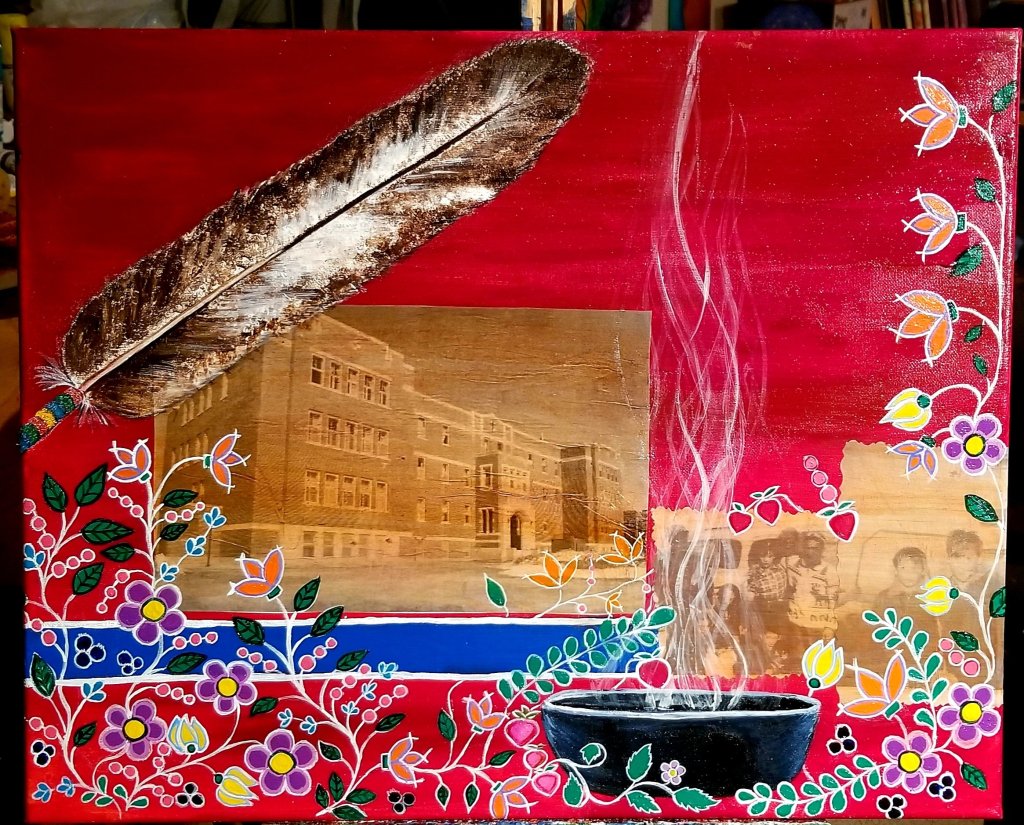
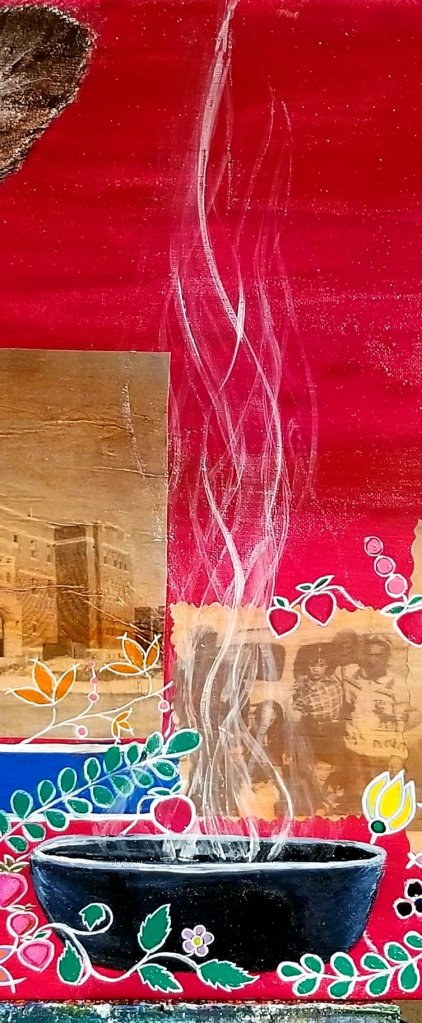
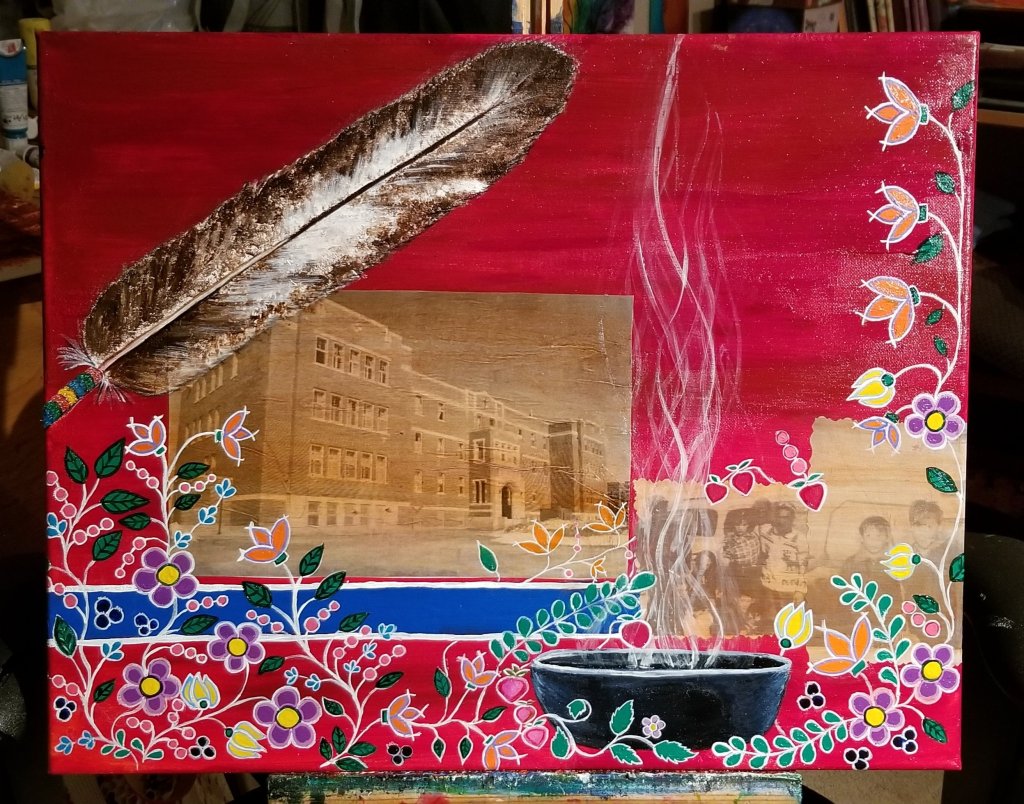
I paint as an expression of what I feel that I cannot always explain with words. Sometimes these paintings come to me very clearly as this one did. I had been thinking about how much my family has been impacted by residential schools, how colonization has affected us and how these things are passed on generationally.

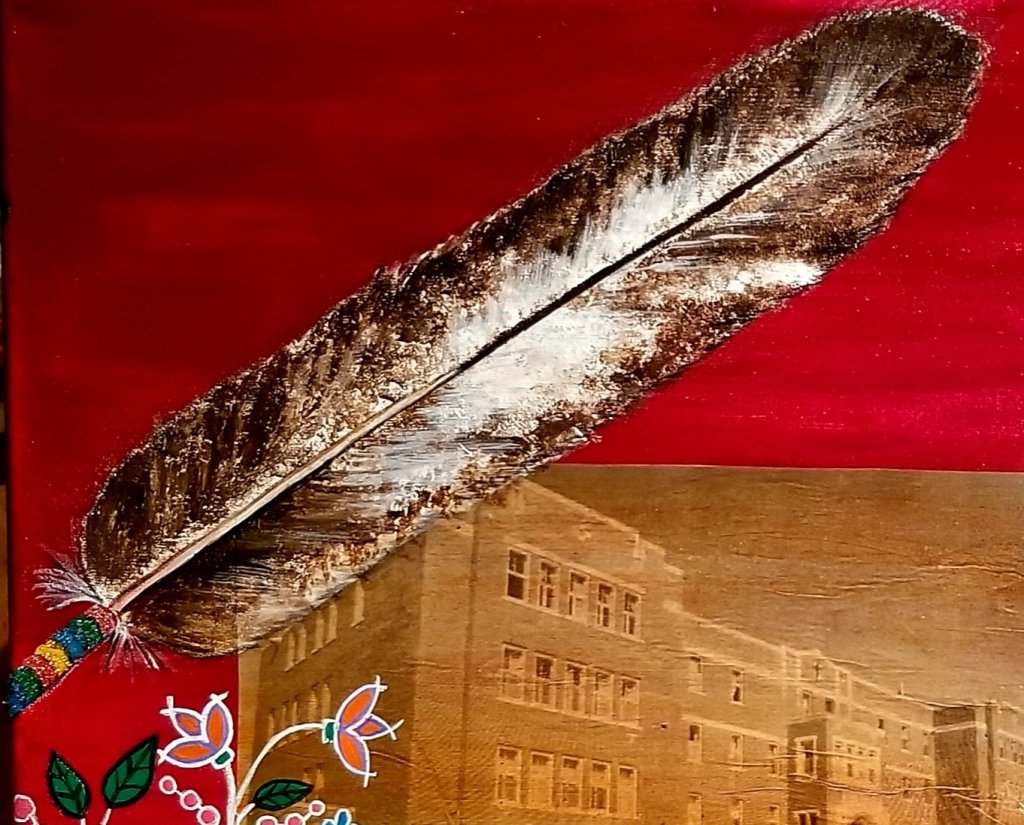
This painting represents how imposing blue quills has been on my family. There is a lot of intergenerational trauma because of it. We had multiple generations of family members attend this s hool.

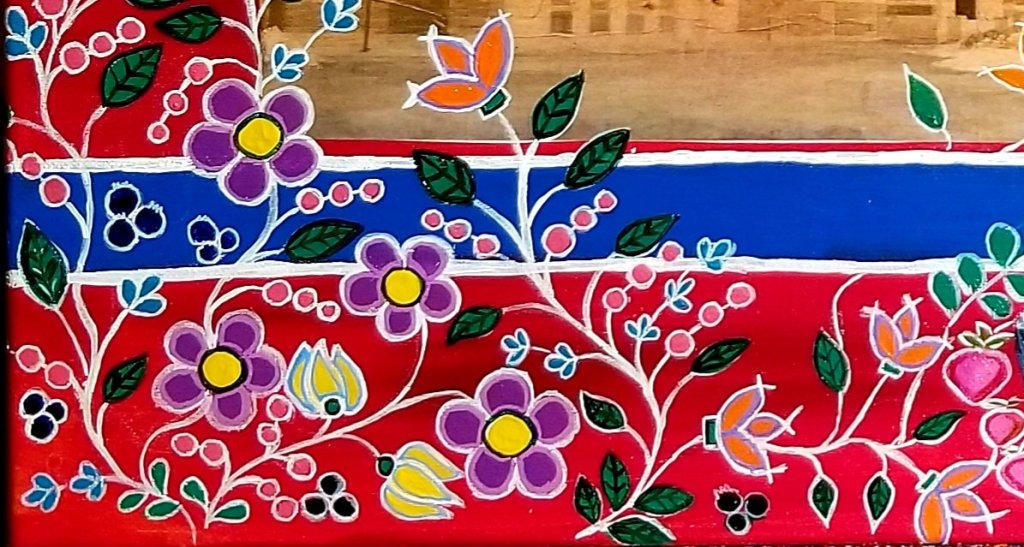
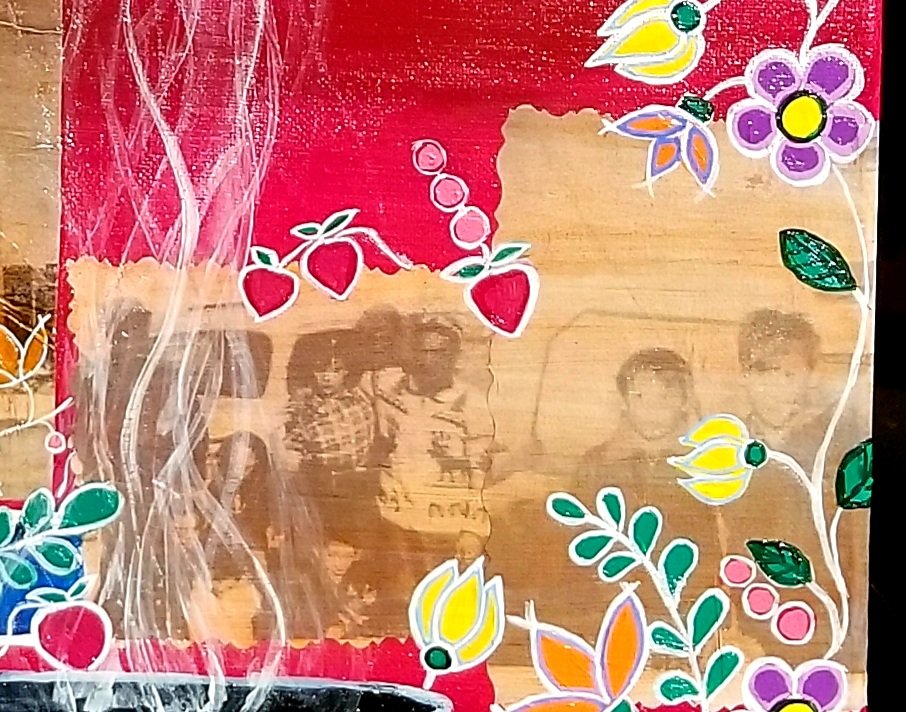
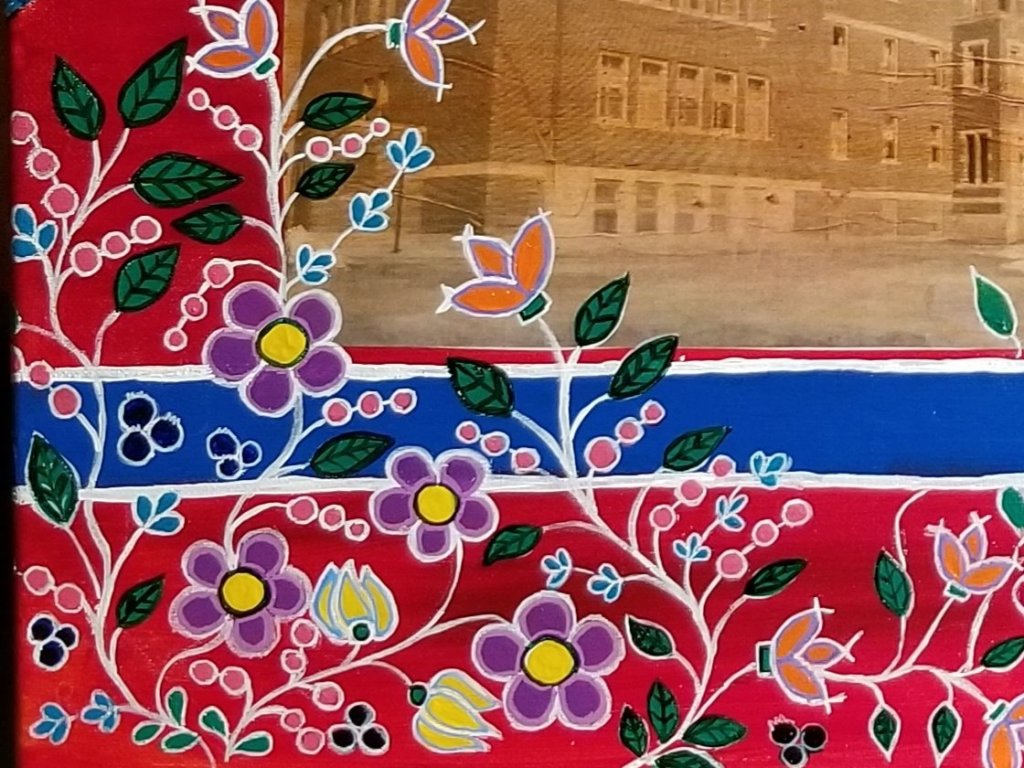
Flowers represent medicines to me. The flowers are growing over the photos and bringing healing and change. Medicine comes in many forms.

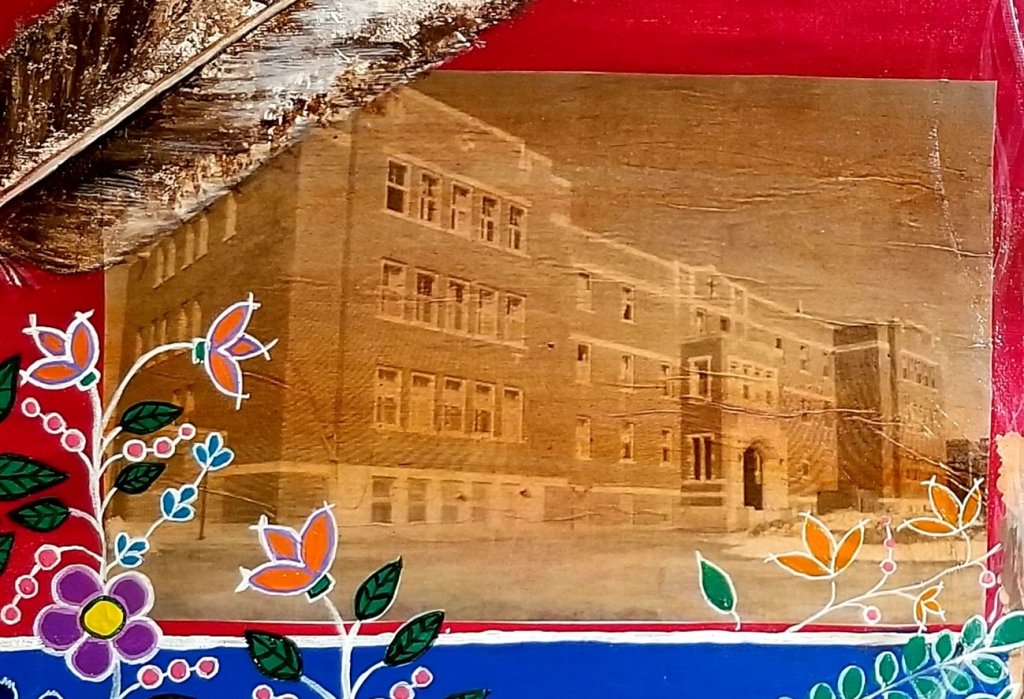
The photo of blue quills is large because it had a huge impact. It’s not covered because it will never go away.

The smudge and eagle feather are clearing away the pain through reconnection to culture. Culture is medicine.

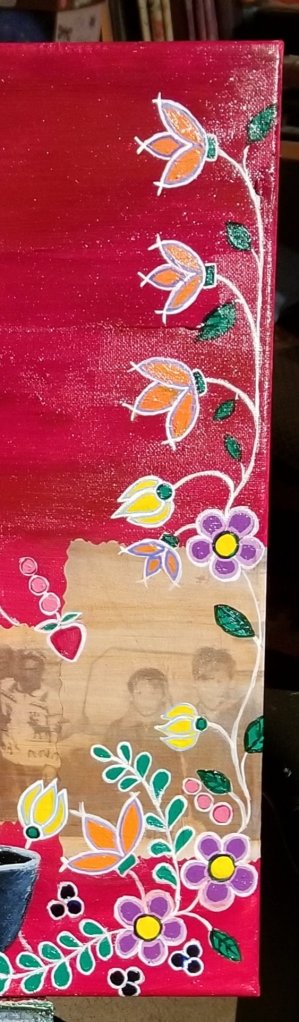
Each one of the flowers represents someone in my family. The purple ones are my dad and his siblings. The yellow ones represent myself and my siblings that’s why there are 5 of them. The orange ones are my parents grandchildren. The pink dots represent all of my cousins. The berries represent change and new growth. The sage also represents growth through healing. There are two photos of my family members as youth when they would’ve been in Blue Quills Indian Residential school

The background colours are there because of how this painting came me. Red is understood to be connected to healing, it is also understood to be the only colour that spirits can see.

Overall the painting is like a prayer for healing, separating my family from the school and the impact it’s trauma created.

Nista Mina

I wish I could speak my language. I know words but not conversations. I hear words I recognize but cannot understand. Some words come to me.

Pikiskwe – speak

Astum ota – come here

Awas – go away

Mitsoh – eat

I know words and sometimes I hear answers in my mind…

Tansi -namoyananto ekwa kiya

…but my mind says “I’m fine, how about you?”

Someone gives me something, my mind says ay-aye but I answer in English and say thank-you.

Kekeway oma? What is this?

I have lost my words. I have lost my conversations and now only in my mind I speak.

Healing

This painting represents how imposing blue quills has been on my family. There is a lot of intergenerational trauma because of it. This place caused a lot of physical, emotional and spiritual pain for my family. My dad and all his siblings attended there. My mosom (grandfather) and his siblings attended there. My Chapan, great grandfather he was fortunate enough to not have to go to residential school. However he did have the experience of losing his father at a young age, when his father was murdered during the 1885 northwest rebellion . (That’s another story)

This painting came to me one night while I was thinking about the impact that residential school had on my family.

The flowers are growing over the photos and bringing healing and change. The photo of blue quills is large because it had a huge impact. It’s not covered because it will never go away.

The smudge and eagle feather are clearing away the pain through reconnection to culture.

The photos are of my dad and his siblings. Each one of the flowers represents someone in my family. The purple ones are my dad and his siblings. The yellow ones represent myself and my siblings that’s why there are 5 of them. The orange ones are my parents grandchildren. The pink dots represent all of my cousins. The berries represent change and new growth. The sage also represents growth through healing. The background colours are there because of how this painting came to me.

Returns

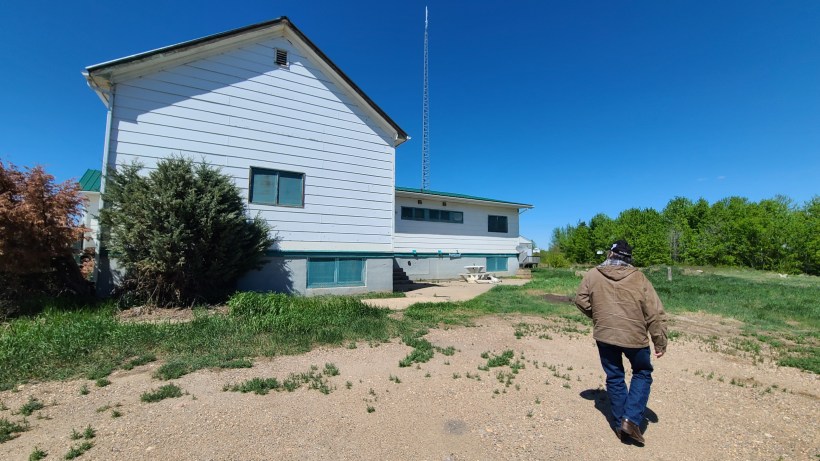
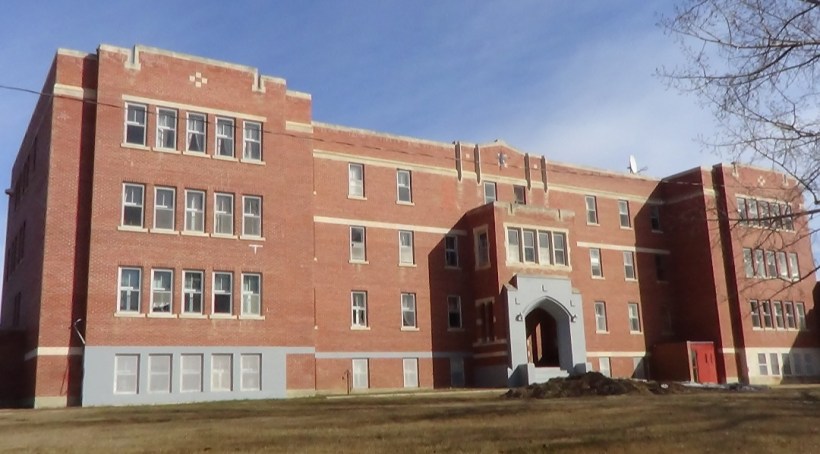
I walked into the school my father once attended never knowing he had been there before. I saw the Nehiyaw culture every where I looked but I felt something there that was unexpected. I felt dread and emotion that I did not understand and I thought it was because this was a residential school.

I thought that because I knew this had been hallways and dorms

where children were brought,

where they did not feel safe,

where bad things had happened,

that this was the reason for my fear.

I walked down the hall to where the library now stood, where once a chapel had been. I felt dread and disconnected from the reality of where I stood. I left and felt glad to be shedding the feeling of this place. Perhaps it was all in my head.

I returned home and told my father where I had been and where I had stood. He asked me why would I ever go there. I said I was there to learn about its history and its place now, as it tries to return culture to the people it stole from. I said “you should come there with me some time. There’s culture and language everywhere.” He looked at me and in a shaky voice half shouted “I will never go back to that fucking place.” I was shocked and shook to my core. I did not even think about my dad being in school there.

I remembered then the stories he told, brief though they were, of the nuns and how mean they were in school. I paused and I questioned, “I thought you didn’t go to school there.” He said quietly “It was only two weeks.” I did not say anything else but I thought his reaction was too strong for only two weeks. I didn’t ask again.

I went back there…to the school of two weeks…wondering how this place connected to me and my history. How was it connected to the pain my family experienced and as if the school could read my thoughts, I could not find a way into the building. None of the doors would open although there were clearly people inside. Someone came out and I caught the door and went in. The same feeling of dread surrounding me as I walked down the hall. I went to meet the person I had come to see, unfortunately, she had been called away for a family emergency. I left the building and immediately felt better.

Twice more I came to the building and was shut out. Twice more I left without answers. Then I went to a ceremony being held on the school grounds and I prayed that my dad would feel safe enough to tell me something; I shed tears for him.

A few days later my parents called. They said “can you please come here, we need you to look at some papers.” I went to their home and my dad handed me a brown envelope; he turned and walked away. I sat down at their kitchen table and asked my mum what it was. She said its about the time your dad spent at residential school. I said oh. I felt emotionally flat. I said I thought it was only 2 weeks. My mum said “no its longer and they only know he was there because other people identified him”. The school otherwise had no real records of him.” I felt anger burn in the pit of my stomach but I also felt sick. I asked “how old was he”….my mum said “just read the papers.” So I did.

It identified his timeline as at least two years and two months. I felt sick. I asked “What does this mean” I felt bewildered and confused. My dad came and sat down next to me. He asked “what should I do?” “They want me to go and make a statement.” I asked him “Do you want to?” He was unsure, unsure if he should open old wounds, unsure if he should talk about it, unsure if it was safe to do so. We smudged and prayed and I went home with even more questions.

I knew my uncles and aunties had gone to school there, they had said. My Auntie told me that they didn’t learn to read or write, that they had learned how to pray and to know that they weren’t good enough. She said my uncles learned how to work farm jobs. My Kokom had told me that they had been treated worse than dogs and that everything was rationed, they had to make do. Yet I couldn’t figure out why I didn’t think my dad had gone to school there. I guess because he never really said anything about it and because he had a substance use disorder, it wasn’t something that every crossed my mind. Now I had more unanswered questions. I also knew why my dad would walk away when anyone talked about going to school.

My dad called me a couple of days later and said “I’m going to do it but only if you and your brother will come with me and please ask your friend Wanda to come with us.” I said ok. nothing more, no questions just ok.

The day came for the independent hearing and I was nervous. We smudged and prayed. I gave my dad the things my children had given to me for Mosom; rocks for strength and a letter telling him that they knew he would be ok.

I listened to my dad’s story, the terrible things that had happened to him, the fear he felt, the pain he experienced and how it impacted his life. He he had suffered from depression, anger and suicidal thoughts for years. How he couldn’t be the father that he wanted to be but how he wanted to be a better Mosom. He showed them the gifts the kids had sent for him. WE were all crying. I understood my sense of dread and fear connected to that place.

I heard his story and understood my father on a different level. I saw him as a child, who had survived a horrible experience. How his dependence on alcohol for so long had kept him from thinking about those experiences and how his years of sobriety had helped him tell his truth.

I continued to go to that school to participate in the ceremonies every year that are held there. I always asked him if he would come. He always said no until about 5 years ago when he said maybe. Then he came with me. He was nervous and scared. As we drove closer he talked about the evil of the place and how much he didn’t want to be there. I asked him “do you want me to turn around?” He said no. We arrived.

He had returned. My nephew, the youngest grandchild at the time, was with us. He took his Mosom’s hand and we walked towards the building. My dad walked up to the building, took a breath and walked in. He had returned to his place of terror. He could only get through the door but that was more than I had expected. I felt proud of him. My mum looked at me as my dad said I need to leave the building and my nephew walked out with him. They walked around the grounds and we gave them time. Then we left. My dad seemed somehow lighter as we left.

The return was powerful, as was the ability to choose to leave. He had gained some freedom and I told him he didn’t ever have to go back there unless he chose to again. My parents, my nephew and I have gone back only once since then to attend a ceremony on the grounds but never to the building. I doubt if he will ever return to the building now that he has freely walked away from it.

Silence

Silence,

It is deafening in its stillness and quiet

Kista?

Awina?

Neya.

I am silent.

I am mute.

What do I say?

These words are lost to me.
These words I should know.
Tapwe.

I should be able to speak but I am silenced.

The nuns and the priests they took away the language.

I heard it in my youth.

My father’s first language. He learned not to speak and to remain silent.

It is spoken to others, who also spoke…those not totally mute, not totally silenced but still they did not speak it to me. I am silenced.

Sometimes words want to come, not lots of words only some. Then fear takes hold and they go away.

I do not know enough language to get by.
I know a few words but still fear gets in the way so I remain mute.

Silenced.

The silence is deafening in its stillness and quiet.

Thanks to that school I am silent. I am mute.

Speaking my truth

I have had more people than I expected ask me what it was like to share my story at the TRC. I have to say it was one of the most difficult things I have ever done. It was scarier than anything I have experienced and at the same time it was very liberating.

I had considered, how much do you share when you tell the story of your experience. It is not just my experience but also the experience of my siblings, my parents, my aunts and uncles and cousins. It directly impacts them. It exposes things that you learn not to talk about. It is a fearful thing to break the rules of silence because it is not just our family rules but it is also societies rules of silence.

It is about shining a light on truth that people would rather not see and then giving them a reason to say they knew I was screwed up and now here is the proof because I just told everyone what happened in my family.

FEAR, it is so powerful. It can rob you of independence and steal your dream. It is the great silencer. Fear is one of the most difficult things to overcome. It is surrounded by what ifs and anxiety. It is why I had nightmares for years. The only way to overcome fear is to open yourself up to love and truth. Even miserable rotten truths are better than living in constant fear.

So my truth was spoken in a deeply painful and personal way. I cried a lot at the TRC. I cried because I felt alone, even though I wasn’t. I cried because my family wasn’t there. I cried and grieved my losses. I cried because of the shame I grew up with and I cried because in all those things I experienced were teachings. Some of these were not healthy and others well honestly gave me strength to endure. So as scary as it was, as painful and as difficult as that experience was, I am glad that I did it. I wish that more people would have been able to do it but to those who did, I am so grateful, they were able to share their stories. In telling the story we all gained a little more freedom. And if you really need to know more well, I’m open to telling you about it as long as you are open to listening without judgement.