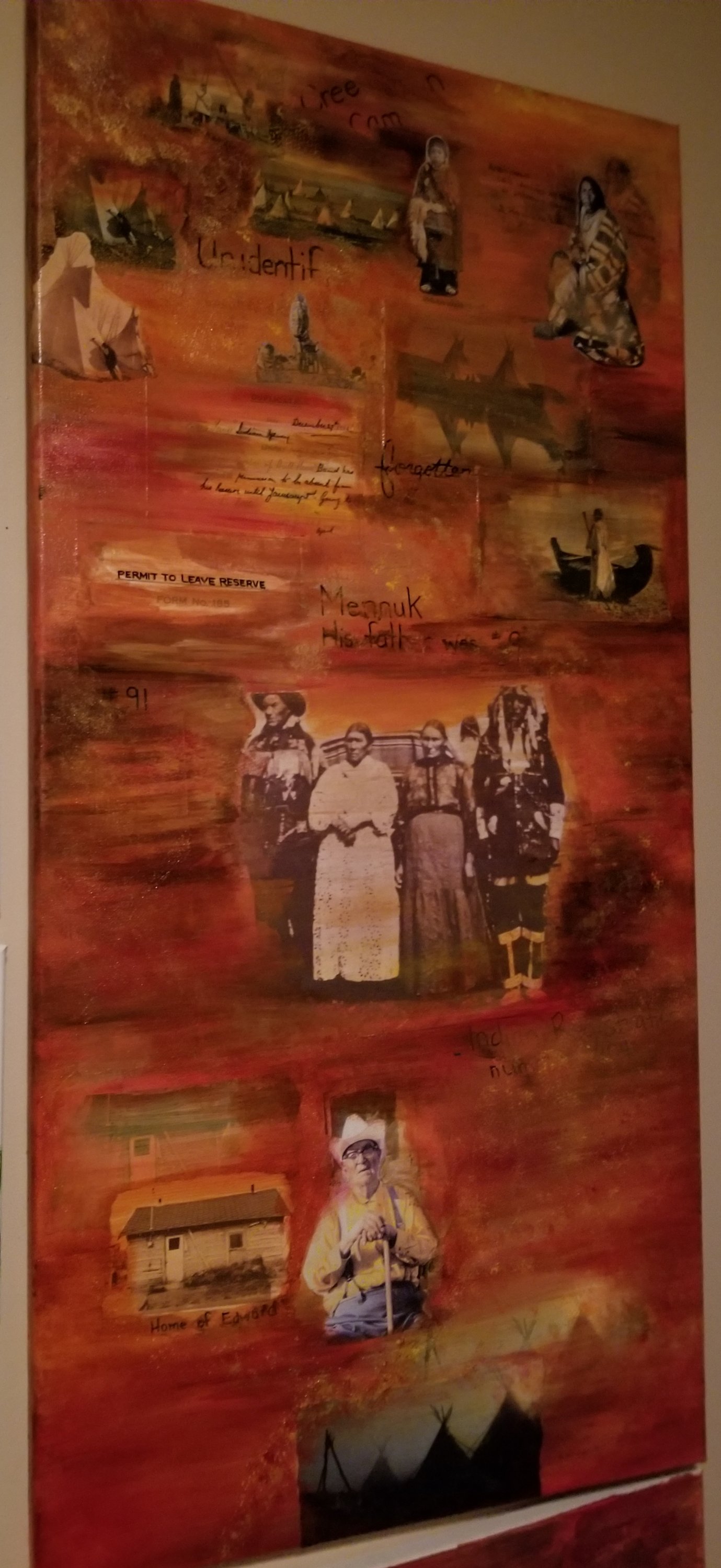
I’ve always been interested in history. I think it’s a family thing, my parents always told stories about historic events. There was a day my late uncle Archie brought me a bunch of old papers he found at the dump. He asked me to look through them and see what I could find. They were photocopies of black files from the Saddle Lake agency. These were a history that validated a lot of the stories. These records were of the interactions between the Canadian governments Indian Agent and the department of Indian affairs. They told a story of what happened in the community but are very one sided. These files are available through the Canadian archives.
This selection of papers my uncle gave me started me to looking for more information as i wondered if there was anything directly related to my family. When I was looking for more records online I somehow became distracted by old photos. I began looking at these old black and white photos online and became increasingly annoyed by what I saw.
What bothered me was that the photographers took the time to take photos but not the time to know whose photo they took. Sometimes if there was a European person in the picture, his name was included. Most often the pictures of the indigenous people said “unknown Indian”, sometimes “anonymous indian” or sometimes they named the tribe from where the person originated. What bothered me was that these were someone’s family members. They lived, they were loved and not forgotten when they died.
It bothered me because my great great grandparents could have been in those photos and I would never have known. It bothered me because the history I had been told about my dads side of the family is a sad tragic tale. It is inherently one of loss, loss of land, loss of culture, loss of freedom, loss of language, and loss of life.
My mosom Mumstahp’s father Memnook (sometimes spelled Maymenook) was killed in the great war. This isn’t world war 1, this is the 1885 northwest rebellion or resistance. Our family called it a great war. The story of his death is another tale. His father was named Witokan. We are told that he passed before treaty 6 was signed. We are told that he and his 6 brothers were the first to sign on the treaty at Saddle Lake. It was agreed to by them and ceremony was held at the corner where our family has their land.
After the treaty was signed all the family members received registration numbers, their names were included on the new band list. Maymenook was number 9 on the Saddle Lake band list. He was killed in May of 1885. His story was forgotten, not part of the Canadian history I learned in school. My mosom Mumstahp was given number 91 when he got married in 1904.
After the war the government, which had already broken many of their treaty promises created a list of “disloyal Indians”.
They needed permission from the Indian agent to leave the reserve, they needed permission to sell their produce. It was illegal for them to buy stamps, to hire a lawyer, to vote, and to gather, to practice culture and traditional beliefs. The government was trying to erase everything about who they were.
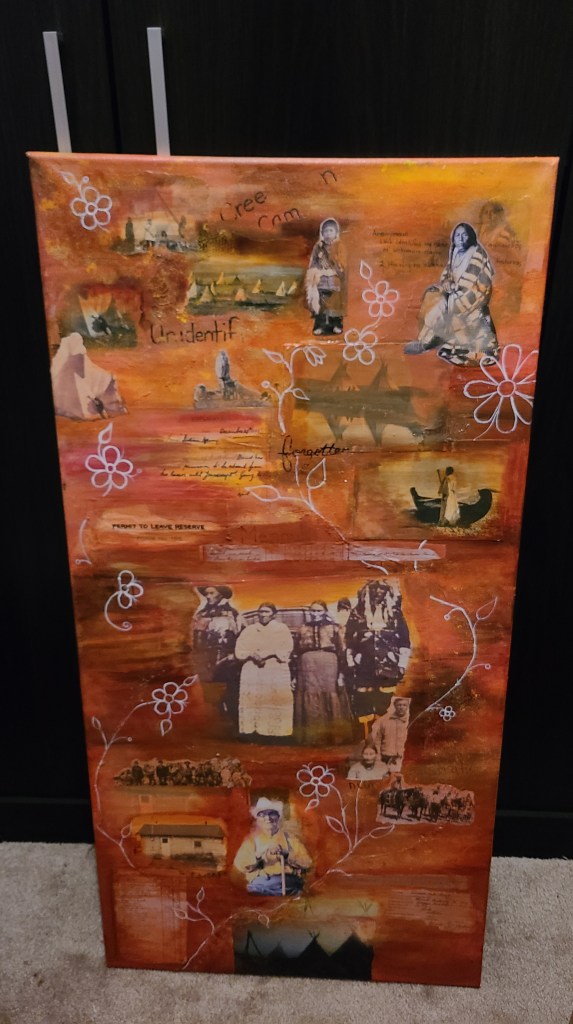
This painting is my way of illustrating that we are always connected to the past. We are connected by stories and shared history. Mosom Mumstahp was at least 106 years old when he passed away. I was 6.
This painting travels through history to connect with him with both the past and the present and it ends with the photo of tipi’s. The connection is illustrated through the flowers that wind through the painting. The tipi’s are a picture I took one morning when I was at the Saddle Lake cultural camp.
To me it shows resilience, that though much had been oppressed, we survived inspite of those who tried to erase Nehiyawak/Cree culture. It shows that those in the past are still connected to who we are today.
This painting represents hope. That although society saw a group of people and wasn’t interested in them; that society would rather forget about them, we are still here. It shows that the strength of our ancestors still resides in us.
I recently added to this painting, as I’ve learned more of my family history. I wanted to include elements that occurred to Mosom Mamstahp during his lifetime. I included a paylist, photos from life events and images on their numbers on the paylist.
We are still connected to what our ancestors experienced. It is part of who we are. The photos of those unnamed group of Cree people are still who we come from.
 Sakaw Iskwew
Beautiful but unfortunate that a heaviness of emotion lays in the forefront of creativity. But, I find that bringing forth the truth in a way that allows beauty to be seen rather than the ugliness is a way to capture the resilience of our ancestors. ay hay for taking the time to bring your vision and words to light. Ninaskamon
LikeLiked by 1 person
Thanks for taking the time to read it. For all the intergenerational trauma that exists we also have intergenerational resilience ❤️
LikeLike